Dual-Task Motor Compression and the Forced Emergence of Technical Automaticity in Elite Football
Introduction
At the highest levels of football, technical failure is rarely the result of ignorance or insufficient repetition. Players operating in elite, performance-driven environments have already accumulated tens of thousands of touches and possess well-defined mechanical solutions to ball manipulation. And yet, under demanding match conditions, those same players often exhibit degraded touch, delayed execution, or unnecessary visual dependence.
These failures do not originate in the foot. They originate in the nervous system’s inability to sustain conscious technical control while simultaneously processing the perceptual, emotional, and tactical demands of the game.
The issue is not that players lack technical knowledge. The greater problem is that execution still depends on conscious control. When a player must actively monitor a technical action, that monitoring competes with scanning, anticipation, and decision-making. In live match play, attention is constantly pulled away from technique, and execution deteriorates.
The only reliable solution is to remove the need for conscious control altogether. This requires automation at the neurological level. Stylistic repetition and surface-level consistency are insufficient.
This paper outlines a constraint-based intervention designed to accelerate that transition. It does so not by refining technique directly, but by creating conditions under which conscious technical control becomes impossible, forcing the nervous system to reorganize how the skill is executed.
The Rationale for Forms’ Dual-Task Interference Protocol
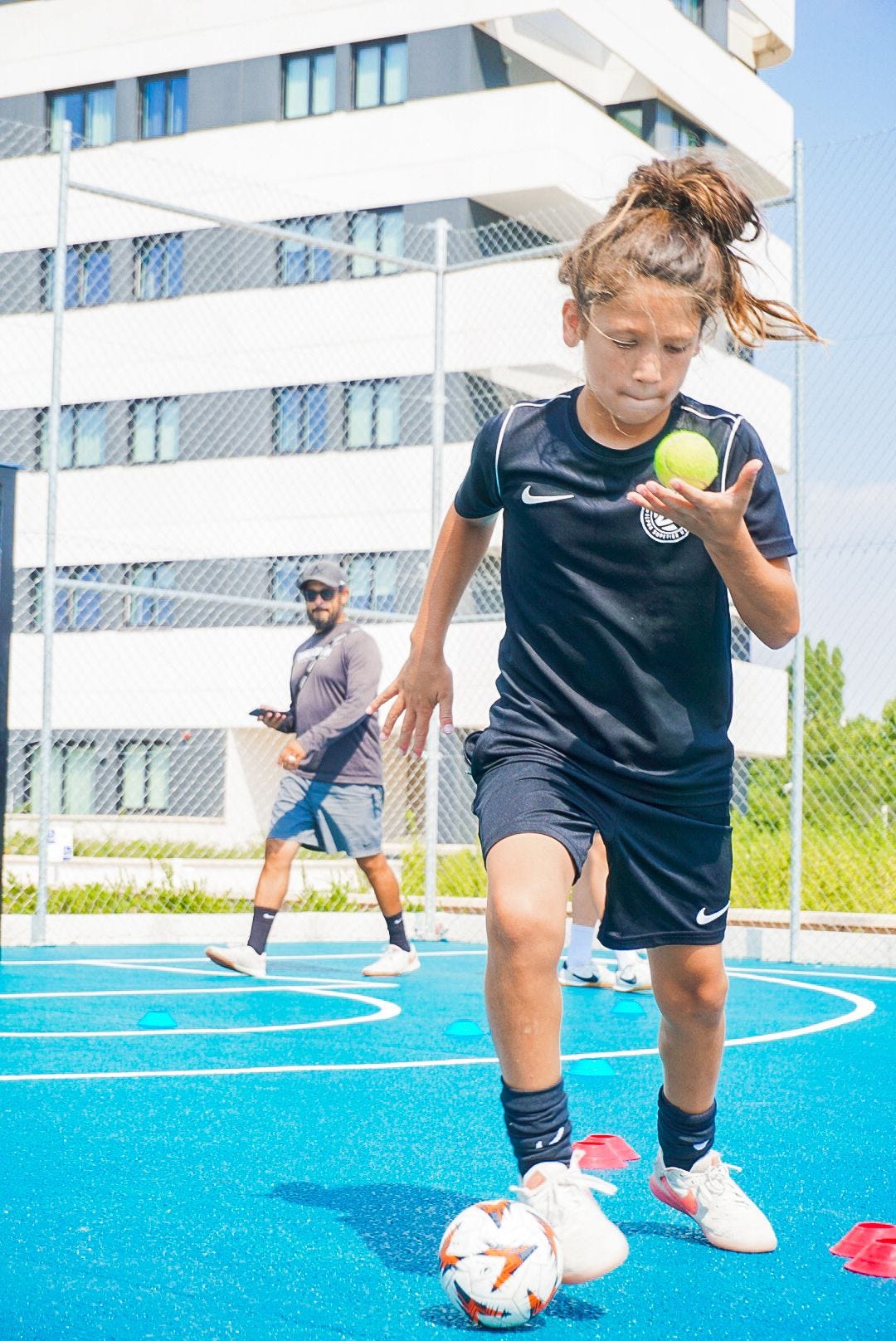
The intervention pairs continuous lower-body ball manipulation with simultaneous upper-body object manipulation, most commonly using a tennis ball. The player is required to sustain ongoing dribbling actions while performing secondary hand tasks such as rhythmic bouncing, vertical toss-and-catch sequences, cross-body handoffs, or rapid release–reacquisition actions that demand precise temporal control.
The purpose of this pairing is not coordination in the colloquial sense. The mechanism at work is interference.
This is classic dual-task loading, the same class of interference studied extensively in gait rehabilitation, Parkinson’s research, and the literature on elite skill retention. When executed correctly, it forces the brain to automate the dominant task, in this case, dribbling, because conscious control capacity is insufficient to manage both tasks simultaneously.
Automation is no longer optional. In order to progress, it becomes necessary.
The prefrontal cortex lacks the capacity to consciously supervise two concurrent, time-sensitive motor streams. When overloaded, the system must triage. Either the task collapses, or control is transferred to lower-level neural circuits capable of running motor programs without constant supervision. If the technical action is sufficiently learned, the system selects the latter.
Neurological Mechanisms Underlying the Effect
Under dual-task conditions, the attentional system becomes saturated. The player cannot visually track the feet, monitor hand position, and maintain spatial awareness simultaneously without degradation. This saturation initiates a process often referred to as cortical shedding.
Consciously controlled processes are progressively offloaded to subcortical systems responsible for habitual movement, timing regulation, and error correction.
In practical terms, this manifests as reduced visual fixation on the ball, stabilization of touch rhythm despite attentional diversion, and continuity of movement without pauses for recalibration. The player does not decide to trust their technique. The system removes the option to supervise it.
At the same time, proprioceptive feedback is reweighted. As the upper-body task intermittently captures visual resources, the nervous system must rely more heavily on kinesthetic information to regulate foot-to-ball interaction. This shift is essential.
High-level ball mastery is not visually guided. It is proprioceptively anchored. Dual-task interference accelerates the transition away from vision-dependent control toward internal body–ball mapping.
Upper-body tasks that cross the midline further enhance the intervention’s effectiveness. Cross-body handoffs and orbiting movements demand bilateral coordination and interhemispheric communication. Rigid motor patterns are subtly destabilized. Segmented control strategies soften.
What emerges is whole-body integration, a prerequisite for fluid movement under pressure.
Why the Method Is Commonly Misunderstood
Many coaches misclassify this type of work as coordination training and dismiss it accordingly. That dismissal is understandable given how coordination drills are typically implemented. Most coordination exercises are serial or sequential rather than parallel. Under sequential application, the athlete completes one action, then another; therefore, true simultaneity is absent, which keeps cognitive load low and conscious control preserved rather than stressed.
Forms’ interference protocol differs here, where the distinguishing feature of this intervention is not its complexity, which is often misunderstood, but its concurrency. The player must sustain continuous lower-body execution while responding to upper-body demands that introduce temporal unpredictability and attentional disruption.
The tasks do not alternate. They interfere. That interference is intentional. It is the mechanism for accelerating adaptation.
Transfer to Match Conditions
Football is not a single-task environment. Even in moments that appear technically simple, players simultaneously scan, anticipate contact, manage emotional arousal, and position themselves relative to teammates and opponents. The technical action must survive this context, or it is functionally incomplete.
The described intervention is occasionally criticized for lacking surface-level similarity to match play. That criticism misses the point. The exercise is not game-like in appearance, but it is game-equivalent in cognitive structure.
In matches, attention is constantly diverted away from the ball. Opponents, space, and tactical cues dominate visual and cognitive resources. A player whose ball control collapses when attention shifts has not achieved functional mastery.
Dual-task motor compression directly addresses this vulnerability.
Players exposed to this type of training demonstrate faster re-engagement after disruption, reduced touch-degradation under pressure, and greater execution stability when visual information is incomplete or delayed. These outcomes are not stylistic preferences. They are prerequisites for sustained high-level performance.
Boundary Conditions and Proper Application
The intervention is effective only within specific boundaries. If task difficulty exceeds the player’s current capacity, execution collapses entirely. Touch quality degrades beyond recovery. Movement slows unnaturally. Compensatory strategies emerge.
At that point, the system is no longer adapting. It has shifted to survival. This must be avoided.
The target zone is “controlled instability.” Error rates should rise modestly without interrupting rhythm, posture, or continuity of movement. Visual anchoring to the feet should diminish rather than increase.
When breakdown occurs, the constraint must be scaled back. Active management is essential. This must not be confused with maximal difficulty training. It is precision-loaded difficulty designed to provoke reorganization, not collapse.
Implications for Elite Performance Environments
In elite performance environments where training time is limited and contextual demands are high, this intervention offers an unusually strong return on investment. It reinforces automatic execution without adding volume. It preserves attentional bandwidth for decision-making and environmental interpretation.
It also strengthens robustness without altering a player’s stylistic profile.
The intervention does not replace football actions. It prepares the nervous system to execute them when conditions are least forgiving.
Conclusion
Technical mastery that requires conscious supervision is fragile. Under demanding match conditions, that weakness is exposed immediately.
Dual-task motor compression does not refine technique in the traditional sense. It eliminates conscious control and forces the nervous system to reorganize its execution accordingly. The result transcends aesthetics, yielding a more durable, resilient, and highly functional form of technical expression.
At the highest levels of football, the question should not necessarily concern the player's skill level, but rather the level of skill the player can maintain when attention is elsewhere.
This intervention addresses that question directly.