Constraint-Based Neuromotor Enrichment in Youth Football
Abstract
Dribbling development in youth football is commonly structured around repetition and progressive environmental complexity. While repetition remains essential to skill acquisition, repetition alone does not ensure efficient neuromotor organization. Dribbling is a dynamic coordination problem requiring regulation of the center of mass, distal joint precision, trunk control, perceptual integration, and continuous error correction under changing constraints. This paper examines an upper-body constraint intervention, stabilizing a lightweight pole across the shoulders during dribbling through spatial targets, as a method of neurosensorimotor enrichment. Drawing upon ecological dynamics, Bernstein’s degrees of freedom theory, motor learning science, and biomechanical research on arm swing and balance regulation, the intervention is positioned as a deliberate manipulation of task constraints designed to reorganize coordination patterns. Empirical grounding, pilot observation, dosage parameters, progression structure, measurement strategies, and limitations are presented to situate the approach within a rigorous developmental framework.
Introduction
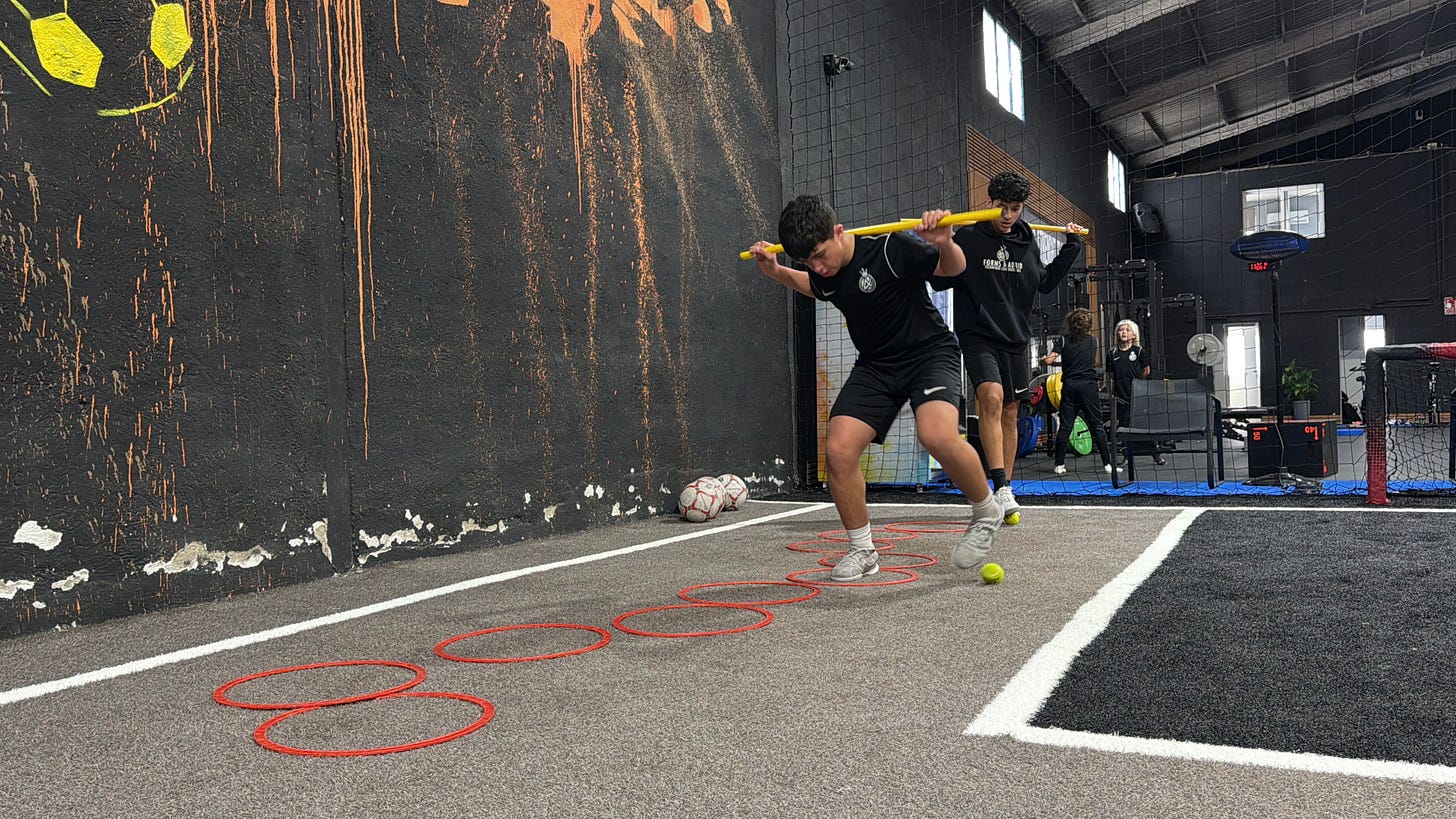
Elite dribbling performance depends on the efficient coordination of the body’s center of mass relative to a dynamically changing base of support. In match conditions, players must regulate angular momentum, modulate force production, maintain ball proximity under perturbation, and recover balance while simultaneously integrating perceptual information. These demands require refined integration across distal joints, trunk stabilization systems, and central predictive mechanisms.
During early development, however, many players stabilize movement through compensatory upper-body strategies. Arm swing, trunk counter-rotation, and reactive shoulder adjustments often conceal deficits in ankle stiffness regulation, hip stabilization, and pelvic alignment. Over time, these compensations become stabilized motor solutions. The visible output may appear functional, yet underlying coordination inefficiencies persist.
Ecological dynamics and the constraints-led approach provide a theoretical framework for addressing such inefficiencies. Skill does not emerge solely through repetition of idealized technique; rather, it self-organizes through the interaction of individual, task, and environmental constraints. By manipulating constraints, practitioners can reshape the movement problem and guide the athlete toward more economical coordination patterns without prescribing explicit technical instructions.
The intervention analyzed here involves dribbling through flat ground rings while holding a lightweight pole across the shoulders with both hands. The upper body is intentionally constrained, eliminating arm-driven balance strategies and limiting trunk counter-rotation. The athlete must regulate ball contact and spatial navigation while deprived of common compensatory mechanisms. The objective is not muscular strengthening. It is the reorganization of coordination under altered informational conditions.
Theoretical Foundations: Constraints and Degrees of Freedom
The constraints-led framework, articulated by Davids, Button, and Bennett, proposes that modifying task parameters channels the athlete’s self-organization processes toward functional movement solutions. Rather than correcting technique through verbal instruction, the coach designs environments that make inefficient strategies untenable.
Bernstein’s concept of degrees of freedom offers an additional explanatory lens. Early in skill acquisition, the nervous system often “freezes” degrees of freedom to stabilize performance. As proficiency develops, variability is progressively released and coordinated more efficiently. Constraint-based interventions may temporarily re-freeze selected degrees of freedom to reorganize coordination before restoring variability under improved structural integrity.
In this case, restricting arm swing effectively reduces the upper body's degrees of freedom. The central nervous system must redistribute control demands distally. Ankle inversion and eversion regulation, hip stabilization, and pelvic alignment assume greater responsibility in maintaining dynamic equilibrium. The athlete is not instructed to stabilize these structures; rather, the task demands it.
Research in locomotion reinforces the mechanical implications of upper-limb restriction. Arm swing contributes to angular momentum regulation, trunk stabilization, and energetic efficiency during walking and running. When arm movement is constrained, trunk rotation increases, and lower-limb coordination adapts to preserve balance. Although gait differs from dribbling, the mechanical principle translates: removing upper-limb contribution reorganizes system-wide coordination demands.
From a neurological perspective, coordination emerges from distributed networks involving motor cortical regions, cerebellar error-correction systems, basal ganglia sequencing processes, and proprioceptive integration. Removing upper-body compensation alters sensory weighting and predictive motor control. Distal joints must resolve perturbations more precisely. Increased reliance on proprioceptive feedback may enhance sensorimotor acuity when task difficulty remains within adaptive thresholds.
Biomechanical Reorganization Under Constraint
Dribbling requires continuous regulation of the center of mass relative to ball position and ground contact. In unconstrained locomotion, arm swing assists in counterbalancing lower-limb rotation and stabilizing trunk motion. Constraining the upper body increases the influence of pelvic stabilization and ankle stiffness regulation. Touches that extend beyond the athlete’s base of support generate immediate destabilization, providing intrinsic error feedback.
The introduction of spatial targets through ground rings further refines stride length and foot placement. The athlete must coordinate ball contact timing with controlled locomotion and postural alignment. Overstriding, valgus collapse, and excessive lateral sway become visible when upper-body compensation is unavailable. The constraint exposes inefficiencies that may remain obscured during free movement.
It is critical to emphasize that football is inherently rotational. Acceleration, deceleration, and directional change rely on controlled trunk rotation and elastic recoil. The anti-rotation effect created by the pole is not intended as a permanent motor template. It functions as a temporary exaggeration, reinforcing foundational stability before rotational variability is restored. Excessive exposure risks promoting rigidity; brief, structured exposure sharpens underlying stability mechanisms.
Dosage, Progression, and Contrast
Motor learning literature emphasizes the importance of challenge point optimization. Tasks must be sufficiently complex to stimulate adaptation without overwhelming coordination capacity. For adolescent players, two to three sets of one to two minutes performed twice per week across a four- to six-week microcycle appears appropriate. Younger athletes require shorter exposures and reduced tempo.
Progression begins with controlled-tempo dribbling while holding the pole without spatial targets. Once postural integrity stabilizes, rings are introduced to regulate stride and spatial precision. Tempo increases incrementally as coordination improves. Crucially, each constrained bout is followed by immediate removal of the pole and repetition of the identical pathway. This contrast phase often produces observable improvements in rhythm and fluidity, suggesting transient coordination enhancement following constraint removal.
Reactive stimuli may be layered only after baseline stability is established. Cognitive load should complement, not compromise, movement quality.
Transfer and Boundaries
Transfer to match performance depends on contextual integration. This intervention does not train deception, perceptual scanning, or tactical improvisation directly. Its contribution lies in strengthening foundational coordination elements that support those higher-order capacities. Improved ankle strategy, pelvic stability, and compact touch radius may enhance tight-space retention and balance recovery under contact.
Limitations must be addressed directly. Overuse may induce stiffness or dampen natural trunk variability. Athletes presenting pronounced proprioceptive deficits or ankle instability should undergo baseline evaluation prior to implementation. The drill must never dominate session architecture and must always be followed by free, expressive dribbling to ensure adaptive transfer rather than rigidity.
Systematic reviews of constraint-led approaches indicate positive trends in skill development, though methodological heterogeneity and limited randomized controlled trials constrain definitive conclusions. This intervention should therefore be viewed as a theoretically grounded enrichment strategy pending further controlled validation.
Synthesis and Developmental Implications
The significance of this intervention extends beyond a single drill. It represents a micro-level illustration of a broader philosophical shift in football training. When coaches deliberately manipulate task constraints, they shape the informational landscape of movement rather than prescribing technique. Skill becomes the product of interaction, not imitation.
Dribbling mastery emerges not from volume alone, but from the intelligent orchestration of constraints that refine coordination architecture. Constraint-based neuromotor enrichment aligns with a developmental model that prioritizes movement intelligence over mechanical repetition.
Conclusion
Elite dribbling performance reflects efficient neuromotor organization across distal and proximal systems. By restricting upper-body compensation, the described intervention compels distal stabilization and heightened proprioceptive integration. When appropriately dosed and immediately followed by free expression, it may enhance coordination efficiency without promoting rigidity.
Future research incorporating controlled comparisons and objective measurement tools is required to strengthen empirical foundations. Within current theoretical and applied parameters, however, constraint-based neuromotor enrichment represents a defensible and strategically coherent component of youth football development.
Advancement in football training will depend not on increased drill volume, but on intelligent constraint manipulation designed to cultivate movement intelligence at its source.
References
Arellano, C. J., & Kram, R. (2011). The effects of step width and arm swing on energetic cost and lateral balance during running. Journal of Biomechanics, 44(7), 1291–1295.
Collins, S. H., Adamczyk, P. G., & Kuo, A. D. (2009). Dynamic arm swinging in human walking. Proceedings of the Royal Society B, 276(1673), 3679–3688.
Davids, K., Button, C., & Bennett, S. (2008). Dynamics of skill acquisition: A constraints-led approach. Human Kinetics.
Guadagnoli, M. A., & Lee, T. D. (2004). Challenge point: A framework for conceptualizing the effects of practice conditions in motor learning. Journal of Motor Behavior, 36(2), 212–224.
Kleim, J. A., & Jones, T. A. (2008). Principles of experience-dependent neural plasticity. Journal of Speech, Language, and Hearing Research, 51(1), S225–S239.
Oppici, L., Panchuk, D., Serpiello, F. R., & Farrow, D. (2018). Futsal task constraints promote transfer of passing skill to soccer task constraints. European Journal of Sport Science, 18(7), 947–954.
Pontzer, H., Holloway, J. H., Raichlen, D. A., & Lieberman, D. E. (2009). Control and function of arm swing in human walking and running. Journal of Experimental Biology, 212, 523–534.
Renshaw, I., & Chow, J. Y. (2019). A constraint-led approach to sport and physical education pedagogy. Physical Education and Sport Pedagogy, 24(2), 103–116.
Wolpert, D. M., Diedrichsen, J., & Flanagan, J. R. (2011). Principles of sensorimotor learning. Nature Reviews Neuroscience, 12(12), 739–751.