The Methodology Has to Be the Constant. Not the Coach
Why “one coach, one voice” persists and why serious development has already moved past it
There is a recurring question that surfaces whenever parents begin comparing environments seriously. It is almost always framed the same way.
A larger club has made a simple, confident claim. One coach for the year is better for the player. One voice creates consistency. Multiple coaches introduce confusion. From that premise, doubt is introduced.
Are we doing this wrong? No. The premise itself is flawed.
It survives because it is easy to understand and easy to sell. It sounds developmental, but it is structural. It reflects how clubs are organized, not how players are best developed. Most coaches were raised inside that same structure, so the idea is rarely questioned, and unfortunately, it's perpetuated.
The argument works because it begins with something true. Consistency matters. Repetition matters. Stability matters. But it misidentifies the source of that consistency.
In a single-coach model, the constant is the person. The same explanations, the same exercises, the same interpretation of the game delivered repeatedly. What is described as consistency is exposure to one individual’s understanding of football, reinforced over time.
That is not a developmental system. Rather, it's a centralized, narrow channel of information distribution.
Once development is anchored to a person rather than a system, fragility is immediately introduced. Remove the coach and the environment resets. Introduce bias and it becomes embedded. Miss a connection point with a player and there is no alternate pathway. Every limitation is magnified because there is no structural counterbalance.
This is dependency, not the consistency it is thought to be. It is a single point of failure presented as stability.
When you step outside that model and examine how elite environments actually operate, the contrast is not subtle.
At La Masia, the player does not belong to a coach. The player belongs to a system. The methodology is defined centrally and applied across all age groups. The same positional principles, the same rondo structures, the same expectations around the ball. Coaches change as players progress. The framework does not. The player’s experience remains coherent regardless of who is leading the session.
At AFC Ajax, the same principle is executed with precision. The TIPS framework, technique, insight, personality, speed, is documented, taught, and protected across age groups. Coaches rotate. Perspectives shift. The structure holds. Development does not depend on continuity of personnel because continuity is embedded in the system itself.
The Croatian Football Federation has extended this idea to a national scale. Coach education is centralized. The methodology is shared. Players encounter the same principles repeatedly across different environments and different voices. The consistency is systemic, not personal.
In Brazil, the distribution of responsibility is even more deliberate. Technical coaches, positional specialists, and performance staff all operate within a unified philosophy. No single coach is positioned as the sole authority over a player’s development, because no high-functioning system would concentrate that level of influence in one individual.
Across all of these environments, the pattern is consistent. The methodology is fixed, the coaches are aligned, and delivery is distributed.
Which raises the obvious question. If this is how development operates at the highest level, why does the dominant model in American club soccer look different?
Because it was not built for developmental precision. It was built for operational efficiency.
The single-coach structure simplifies everything. Communication becomes linear. Administration becomes manageable. Scaling becomes easier because each team is self-contained. One coach, one roster, one parent group. From a business standpoint, it is clean.
There is a second layer that carries more weight. In most American club structures, a coach’s income is tied directly to the size and stability of the roster they manage. The same individual responsible for evaluating a player is also incentivized to retain that player. That alignment is not neutral. It shapes behavior whether acknowledged or not.
The result is a system that rewards retention, predictability, and satisfaction. Not necessarily accuracy. Not necessarily development.
None of this requires bad intent from coaches. The structure does the work on its own.
The scientific side of this discussion reinforces the same conclusion.
Evaluation improves when perspectives are aggregated. This is not seriously debated in any field that takes assessment seriously. Single evaluators introduce bias. Multiple evaluators reduce it. In youth football, removing that structure amplifies known distortions. Early physical maturity is overvalued. First impressions persist beyond their validity. The relative age effect, the well-documented overrepresentation of players born in the first quarter of the year at every level of professional football, is in part an artifact of single-evaluator environments. These are not theoretical risks. They are documented patterns with names.
Motor learning research points in the same direction. Skill is not built through uniform input. It is built through variability. Exposure to the same problem through different constraints, different cues, and different contexts produces adaptability. What appears inconsistent at the surface level is often the mechanism that drives transfer. The literature has a term for this. Contextual interference. The condition that feels harder in the moment is the one that produces durable learning.
Even communication itself does not support the idea of a single dominant voice. No coach reaches every player equally. Some players respond to precision. Others respond to demonstration. Others require a different tone or framing to access the same concept. Restricting development to one voice narrows the probability of connection. Expanding it increases reach.
At younger ages, the argument becomes even weaker. Early development benefits from breadth, not restriction. Exposure, not narrowing. The idea that a child should be confined to one interpretation of the game at the earliest stages runs counter to every serious developmental framework that exists.
This is where most discussions stop. Forms does not stop there.
Because identifying the flaw is not enough. The structure has to be replaced with something that is both coherent and repeatable.
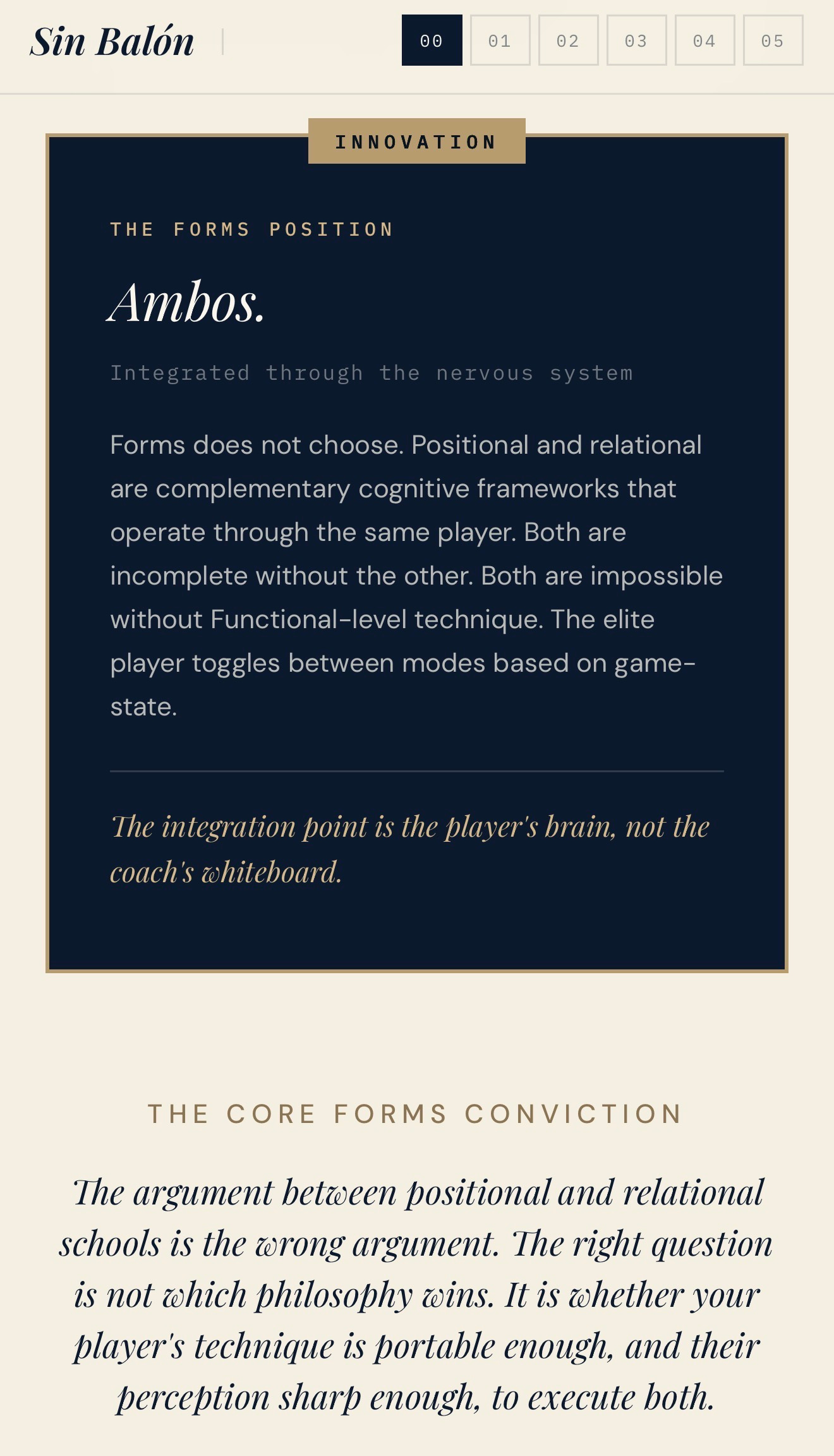
At Forms, the methodology is not implied. It is defined and it exists in writing. FORMAX governs session design, technical progression, coaching language, and evaluation across five domains and five layers. It does not reside in any one coach, and it does not change based on who is delivering it.
That is where consistency is established.
From there, delivery expands by design. Players are exposed to multiple coaches operating from the same framework but expressing it differently. One emphasizes detail. Another emphasizes timing. Another demonstrates physically in a way that resolves the concept instantly. The lesson remains constant and the access points multiply.
What initially appears as variation resolves into reinforcement. The same idea encountered repeatedly, from different angles, until it stabilizes internally.
Continuity is preserved where it actually matters. Each player has a primary coach responsible for relationship, behavioral standards, and long-term tracking. The relational anchor exists. What is removed is the illusion that development should pass through a single gatekeeper.
For parents trying to evaluate environments honestly, the signal is not difficult to isolate.
If a curriculum cannot be demonstrated, it isn't a system. Without structural evaluation of coaches, there is no quality control. If the model doesn't match what is used at the top of the game, it isn't aligned with it.
At the highest level, the structure is already established. The system leads; the coaches implement it. This isn't a stylistic choice; it is a structural reality.
The methodology has to be the constant. Not the coach.
Everything else follows from that decision.