Technique Before Tactics: How the Best Footballers Are Actually Built
A note on where this came from. This essay began as a conversation. Someone outside the game kept asking me plain questions about how Forms actually develops players. Why we hold back tactics, why we protect technique above everything, why we let young players solve the game on their own. I gave the short answers first. Then I realized the short answers were the problem, so here’s the long one.
A young Lionel Messi or Ronaldinho would struggle to survive most modern youth academies. They would be told to pass, they would be called selfish. The dribbling that the world now calls genius would be coached out of them before the wiring that made it possible ever formed.
That should bother anyone serious about developing players, because it exposes a flaw at the center of how the game trains its young.
The Question Most Academies Get Wrong
Walk into most elite academies and you find tactical instruction starting early. Positional shape at U8. Pressing triggers at U9. Roles assigned by number before a child can reliably control a moving ball. The justification is that early exposure builds game understanding, and on the surface it sounds responsible.
The real problem is not that early tactics harm a child in the moment. A nine year old holding a defensive line is not damaged by it. The problem is opportunity cost. Seen through that lens, the conventional model runs backwards.
One clarification up front, because the argument is easy to misread. This is not a case for chaos, and it is not anti structure. It is not against principles of play, spatial awareness, or collective football. It is against premature tactical prescription: assigning roles before a player has a technical identity, letting coach controlled choreography replace player perception, teaching a child to occupy a position before he can manipulate the ball, the opponent, the rhythm, and the space. Structure is not the enemy. Structure imposed too early, before the player has the tools to use it or break it, is.
The Window
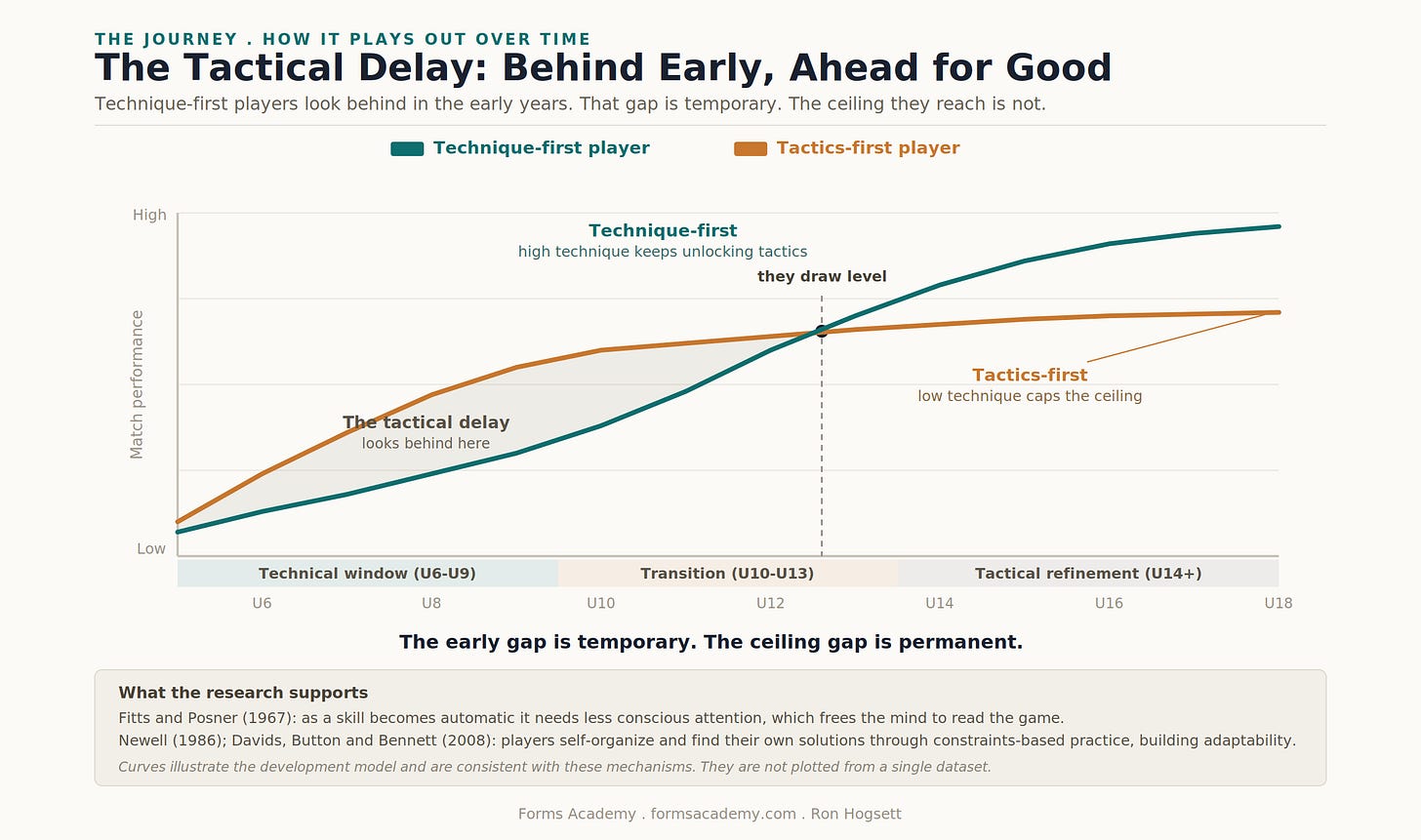
There is a high leverage developmental period, roughly through the primary school years, when technical habits, coordination, ball feel, and perception to action tendencies can be set with unusual durability. It is not a magical cutoff and not biologically identical for every child, but it is a period no serious academy should waste. What a player builds in it tends to hold, and it can be refined toward the highest level he is capable of reaching. This is grounded in how motor learning works in a developing nervous system. Thousands of early repetitions turn a skill automatic, so the movement runs without conscious thought, which is what later frees the player’s attention to read the game rather than wrestle the ball. Patterns laid down early move toward that automaticity. Patterns introduced later are always, to some degree, working against what is already there.
That period is finite real estate. Every hour spent on tactical choreography is an hour not spent on first touch, passing accuracy, and body mechanics. The child who acquires positional awareness but only mediocre technique ends up worse off than the child who acquires world class technique and learns tactics later. Technique transfers across any system, any formation, any era. Tactical fluency built on weak technique is choreography, and choreography breaks the moment the game asks something the script did not anticipate. You can introduce tactical ideas relatively quickly compared with the years it takes to build elite technical automaticity. You cannot manufacture world class feet at the end of the process.
Technique Creates Artists, Not Robots
The standard objection is that a technique first focus produces sterile players: technically perfect, tactically blind, unable to read a game. It is wrong, and the reason matters.
First, a correction the critique usually depends on. This is not isolated technique detached from the game. It is technical development placed inside progressively richer football problems, where the ball, the body, the opponent, the space, and the decision are gradually fused. The primacy is on technique. The setting is always football.
A player developed to the highest technical level is not a robot. He is an artist, because he holds the tools to create whatever the game asks. Mastery is not the opposite of creativity. It is its precondition. The painter with full command of the brush is freer than the one still fighting to draw a straight line. And a child spending those years on technique is not in a lab; he is playing the whole time, absorbing space, pressure, and timing without being formally taught them. He will look less fluent in tactical language, which is correct, because he is not meant to be fluent yet. The understanding comes later, and faster, because the foundation is real.
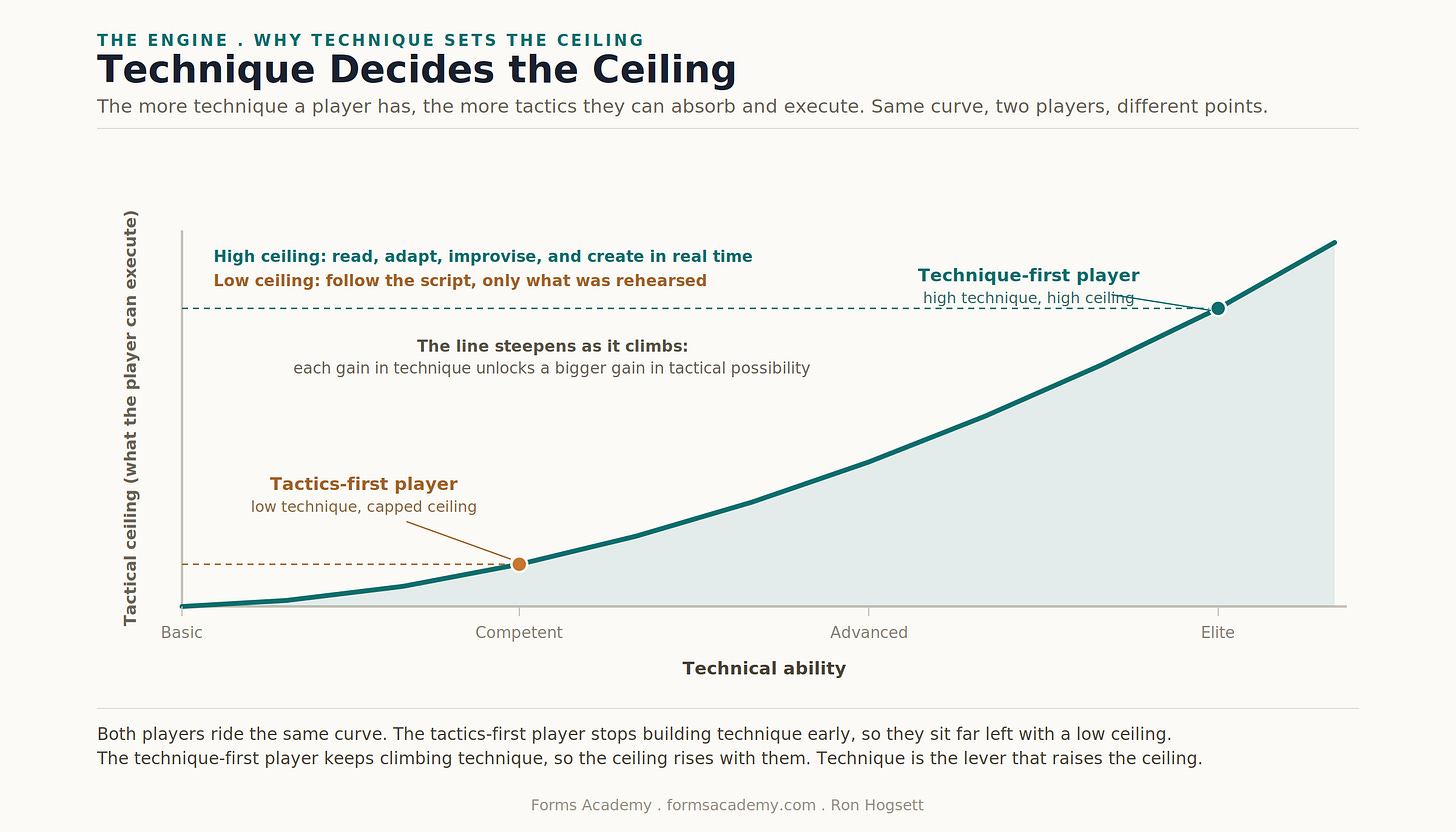
Look at the top of the sport. The common denominator is not a tactical system. It is technical ability. That is the floor every elite player shares. La Masia, the academy that shaped Messi, Xavi, and Iniesta, was built on exactly this: relentless technical demand, rondos, and possession, producing players who then thrived inside the most structured systems in the world. The same logic runs through futsal, the small, fast, high touch game that shaped so many of the most technically gifted players from Brazil and beyond. It forces constant technical problem solving in tight space long before any formal tactical schooling, and the players it produces arrive with the tools already in their feet.
What Tactics Actually Means
You have to define the target precisely. The problem is not tactics in the broad sense of collective understanding, principles of play, or shared reference points. The problem is premature tactical prescription: fixed roles, rehearsed movements, and adult imposed positional answers handed to a player before he has the technical, perceptual, and creative capacity to read the game himself.
“You are the six, you sit here, you cover this space.” That is prescription.
A child in a rondo learning that a pass left means he must shift right to stay available is something else: spatial awareness grown through the demands of the game. The first is imposed. The second is earned.
The deeper objection is to role definitions inherited from the past. A coach who assigns duties based on the football he played years ago anchors today’s players to yesterday’s game. Players now develop earlier and reach higher technical levels than most of their coaches ever did. Imposing the limits of your own playing career onto a more capable generation does not protect the game. It stifles it.
The Dirk Principle
Before Dirk Nowitzki, the role of the big man in basketball was settled. Big men played in the post. Dirk spent two decades honing the shooting touch of a guard in the body of a seven footer, and in doing so he did not only become one of the greatest of all time. He moved the game. The modern stretch big exists because one player’s technical mastery broke a role nobody thought to question.
Football is no different. The next player to change the sport will not be the one who executed an assigned position flawlessly. It will be the one technically capable enough to solve a problem the game had never posed, and free enough to try. So the real doctrine is not a slogan about no tactics before twelve. It is this: do not cage players inside fixed roles drawn from your own limitations. We want the highest level technical players solving the highest level problems the game presents. Football is infinitely dynamic. It needs players capable of producing both the idea for a solution and the execution to deliver it.
Emergent Order
The immediate worry is chaos. If every player is free to solve every problem, does the game not fall apart?
The worry underestimates young players badly. We do not give youth enough credit for managing the game themselves.
If the training environment is designed properly, the game becomes one of the teachers. The pain of disorganization teaches. Players who own their agency, driven by the competitive spirit that brought them to the sport, begin to self organize, because losing hurts and winning is the point. What emerges is stronger than anything drawn on a whiteboard, because they understand why they are doing it. This is not the absence of a coach. A constraints led environment is still pedagogy. The coach designs the task so the player is forced to perceive and solve rather than be handed the answer.
The shift is from players who are obedient without understanding to players who are full of understanding and therefore compelled to execute. The order that emerges is real order. It is simply not the order a coach would have drawn in advance. And the constraints themselves are where growth lives. A player who must solve a problem grows. A player handed the answer does not.
The Coach’s Place
None of this makes coaches obsolete. As players move into adolescence, their capacity for abstraction, reflection, and strategic analysis expands. At that point formal tactical guidance becomes far more useful, because it attaches to a player who already has technical control and a richer internal model of the game. They need more guidance, not less. It simply should not be mandated and dictated.
Coaches and high level tacticians have a real place, and they need to understand its nature. They work with players who may be more capable than they ever were, players who might one day change the sport. That demands humility, and it demands the players be given the respect and freedom the game itself provides. The Messi problem from the opening is the warning: the system too often coaches out the very thing that would have made the player great.
The honest obstacle is ego. The coaches able to build this environment are the ones secure enough to let players lead and to let the game teach. They exist, but they are rare, because most coaching is organized around the need to be right. Most coaches would rather be the architect of a win than the quiet hand behind a player who outgrows them. The hardest problem in scaling a development philosophy is not documenting the method. It is finding people who have made peace with their own ego.
Concept Calls: The Method in Practice
The practical answer to guiding without dictating is the concept call.
Take a real scenario. A young side faces a disciplined opponent in a 4-2-3-1, compact through the middle, pressing the first touch. Your team has the ball and the technique, but has not seen organized pressure like this.
The instinct is to tell players where to go: drop the eights, push the tens wide. Resist it. Give them a constraint instead. A call like “make three connections.” Nothing about where to stand. Just a number to chase.
Watch their minds change. They stop trying to escape the press, stop forcing the ball forward, stop fixating on the goal. The single objective becomes three connected passes. In chasing it, almost as a byproduct, they find advantageous positions, precisely because they are no longer straining toward goal. Three becomes four becomes five. By the end, a team that spent the match under pressure is stringing together seven and eight pass sequences.
Two things are built. Confidence, earned by solving the problem rather than running a script. And doubt in the opponent, because a well structured team has a plan for shape but no plan for an attack that obeys no fixed positional rules. They cannot read what has no pattern.
When the opposing coach adapts, you layer in another concept. Stack. Double stack. Overlaps. Now that coach is the one chasing, trying to decode what your team is doing. The moment a coach has to stop and think about what is happening to him, his structure is already loosening. His goal has shifted from beating you to understanding you, and that shift alone is a win. The edge was never tactical superiority. It was cognitive flexibility.
Why This Is Not Teaching Tactics
The fair challenge: giving concepts, layering objectives, and adjusting to the opponent looks like real time tactical direction. How is it different from the coaching being criticized?
Two answers.
First, the system replicates itself. As players see the concepts work, the captains start calling their own. They have the language, and now they are coaching the team from inside the game. That is scaling a philosophy without diluting it.
Second, and deeper: this is not the teaching of tactics. Pre patternized positional play and rehearsed responses live in the classroom before a game is ever played. The coach teaches a pattern and hopes reality mimics the homework, hoping the opponent obliges by producing the exact situations studied. It does not adapt to an infinite set of circumstances, because no classroom can anticipate them all. Concept calls are contextual. They happen inside the game, in response to the problem the players actually face. And when players begin acting preemptively, reading the problem before it fully forms, that capacity was never taught, rehearsed, or patternized. It is thinking in solutions, made possible only by being qualitatively superior. By technique.
Structure and Freedom Are Not Opposites
The last objection is that the top of the game is full of structure: shape, pressing triggers, transitional patterns. Messi played in systems.
He did. So did Ronaldinho. But they were the players allowed to operate outside their own system. Barcelona did not force Messi into a role. They built the system around what he could do.
That is the reconciliation. Structure and freedom are not enemies. Elite teams hold coherent systems precisely because they contain technically dominant players who can improvise inside them. Structure gives the collective clarity; the best players get license to break it the instant they see something better. A development model scales the same way. Build concept based frameworks that give a team enough coherence to function, and develop players able to see past the framework when the game demands it. You are not anti structure. You are against structure imposed prematurely, before players have the technical tools to break it intelligently.
How Children Actually Learn
Underneath all of it is a truth about learning itself.
Hand a four year old a new iPad. By the end of the day he can work it. By the end of the week he can teach you. Children left to their curiosity engage fully with anything that drives it, given the bandwidth to explore. Now tell that same child only where to tap. He learns the one thing, but never sees the system beneath it, the logic connecting every feature. The first child understands the device. The second understands an instruction.
Football is the same. A player who discovers why a pass works adapts when the situation changes. A player told to make the pass has a script and nothing under it. Teach the instruction and you get obedience. Protect the curiosity and you get understanding. Only one of them produces a player who can change the game.
If you have the kind of question that started this, send it. The next one usually begins the same way.