Beating a Man Is the Most Valuable Action in Football
Most coaching debates about dribbling end in aesthetics. One side calls it artistry, the other calls it indulgence, and both are arguing about taste. The argument resolves differently once you treat football as what it actually is: a probabilistic system that moves between states until a goal is scored or possession is lost. Inside that system, the player who beats an opponent off the dribble is not decorating the game. He is editing its mathematics.
The claim I want to defend is narrow and falsifiable. A technical dribbler who eliminates a defender is the cleanest manufacturer of numerical superiority in the sport, and the modern mathematics of football now measures exactly that. This is not a poster quote. It is arithmetic, and the arithmetic is borrowed from probability theory.
One clarification first, because the entire argument depends on it, and because the title is deliberately a strong claim. I am not asserting that a successful take-on is literally the single highest-valued action in football. It is not. A penalty, a cutback, a through ball, the final pass that drags a goalkeeper off his line, any of these can carry a larger immediate action value depending on the state of the game. The precise claim is narrower and much harder to dismiss: a successful take-on is among the most valuable open-play actions in the sport because it manufactures a state that did not previously exist, and its value rises sharply at exactly the moment passing lanes are closed and the defense is organized. It is not the biggest single number. It is the action that creates the conditions for the big numbers to follow.
There is a second move most arguments about dribbling miss, and it matters more than the first. A player never chooses a successful take-on. He chooses to attempt one. So the real unit of value is not the completed dribble, it is the expected value of the attempt: the probability of beating the man times the value of beating him, minus the probability of failing times the cost of the turnover. Almost every confused debate about dribbling, indulgent versus decisive, collapses once you hold that equation in view. Keep both of these in mind, the state manufacture and the expected value, because together they change what the rest of this essay is even about.
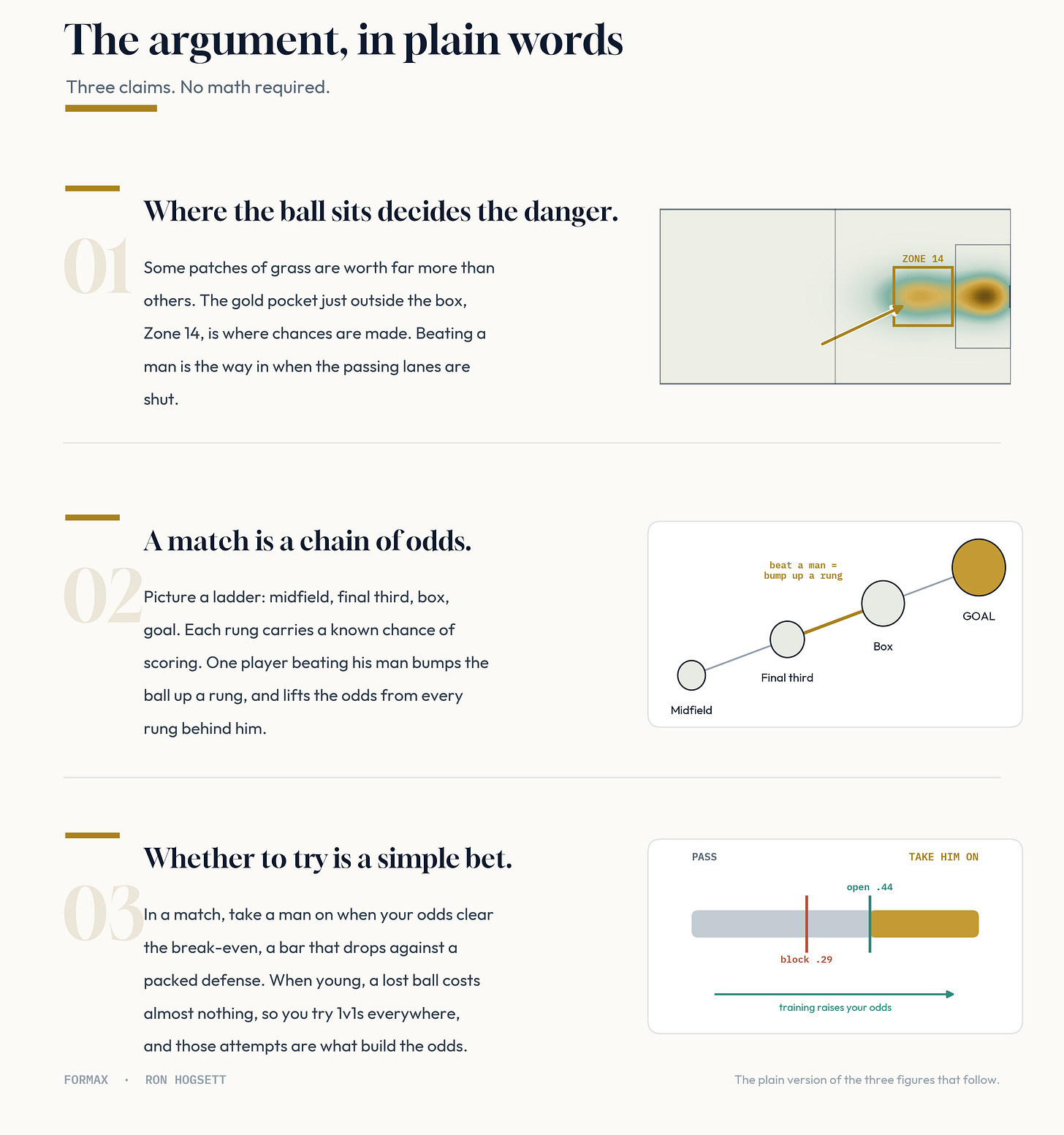
The whole argument before any math: where the ball sits decides the danger, a match is a chain of odds the dribbler bends, and whether to try is a simple bet a packed defense makes smarter.
Football as a Markov chain
A Markov chain is a system that sits in one of several states and moves between them with fixed probabilities, where the next move depends only on the current state, not on the whole history of how you arrived. Football fits this description almost embarrassingly well. Divide the pitch into zones. Each zone is a state. The ball moves from zone to zone through passes and carries, and every possession eventually arrives at one of two absorbing states: a goal, or a turnover. Attach a value to each state equal to the probability that possession ends in a goal, and you have a Markov reward model of attacking football.
Sarah Rudd built the first version of this in 2011, slicing the pitch into a handful of regions and using a transition matrix to estimate the probability of eventually scoring from each one. Karun Singh refined and published the public version in 2018 under the name Expected Threat, or xT. Singh moved to a fine grid, commonly sixteen by twelve, and defined the threat of each zone with a single recursive equation. In plain terms, the value of having the ball in a zone is the chance you shoot and score from there, plus the chance you move the ball somewhere better multiplied by the value of wherever that is:
xT(z) = s(z)·g(z) + m(z)·Σ T(z, z’)·xT(z’)
Here `s(z)` is the probability you shoot from zone `z`, `g(z)` is the chance that shot scores, `m(z)` is the probability you move the ball instead, and `T(z, z’)` is the probability of moving it from `z` to each other zone `z’`. The equation refers to itself, which looks like a problem until you notice it is just the Bellman equation in disguise. You solve it by iteration, and it converges to a stable threat surface after only a few passes. The output is the now-familiar heat map where the penalty area glows and your own corner flag is worth almost nothing.
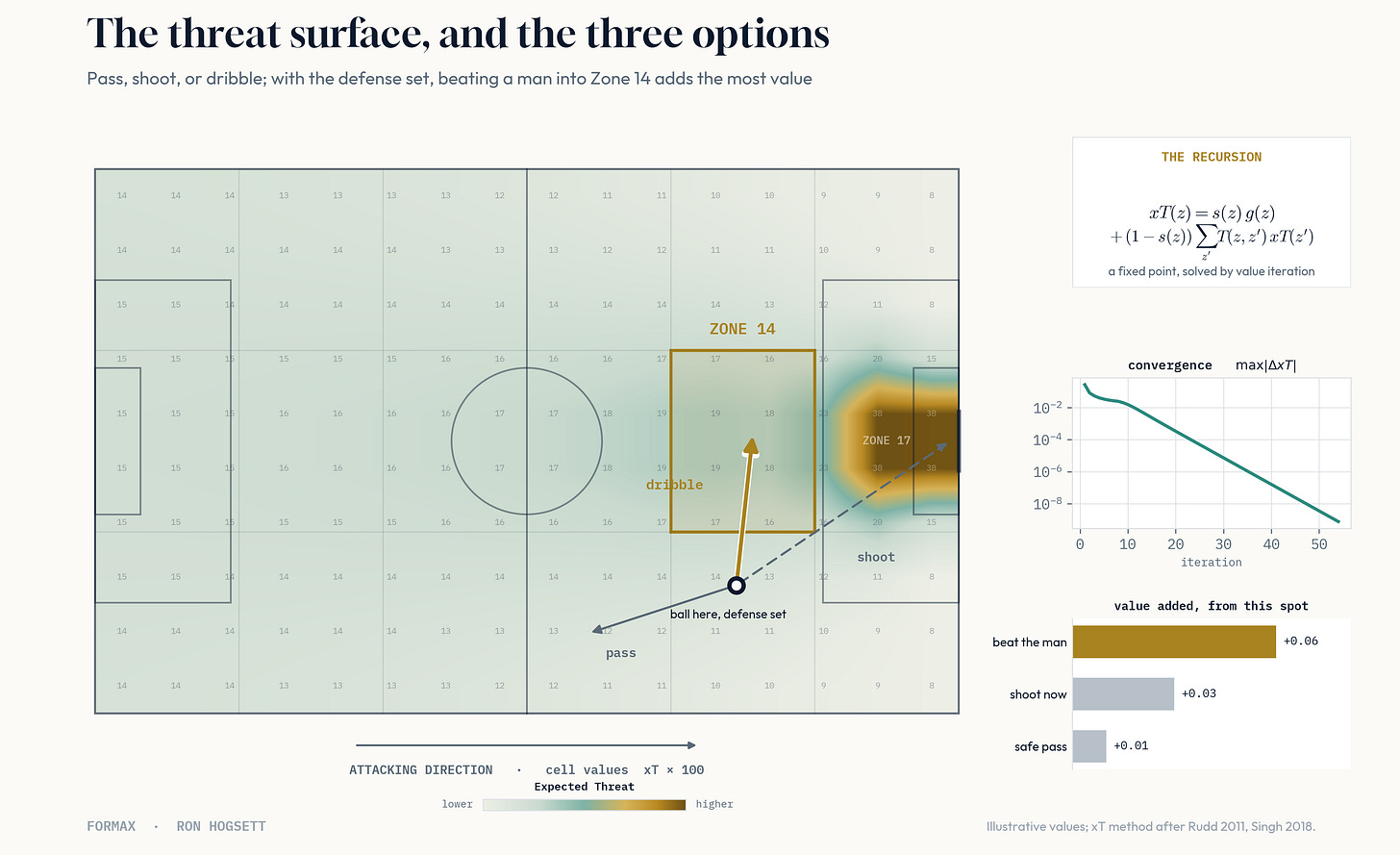
Expected Threat, solved by value iteration, with Zone 14 the prize. With the defense set, the same ball can be passed, shot, or dribbled; beating a man adds the most value, because it manufactures a state the pass and the shot cannot.
Singh himself flagged the structure in his original post. If you have a quantitative background, he wrote, this should remind you of a Markov model where each grid location is a state and passing or dribbling causes a state transition. That is the entire engine.
One honest caveat before we use it, because the rest of the argument depends on getting this right rather than overclaiming. Football is not literally a Markov process. A true Markov chain is memoryless, the next move depending only on the current state and not on the history that produced it, and football plainly violates that. The previous action shapes defensive posture, fatigue, spacing, pressing triggers, the score, the time remaining, and the opponent’s adaptation. Memorylessness is a modeling convenience, adopted in part because event data cannot see the things that carry the memory. Singh acknowledged as much, noting that the exact path of a carry can matter and that running at a defender to pull him out of position is real value the simplified model cannot capture for lack of tracking data. Keep that caveat close, because it is not a weakness in this argument. It is the center of it. The dribbler is precisely the actor who violates the memoryless assumption most violently. His entire value is that he changes the state the next action is taken from, and a memoryless, league-average model is built to ignore exactly that. The places where the Markov approximation breaks down are the places the dribbler lives. Now watch what he does to it.
The transition matrix is an average, and the dribbler breaks the average
Here is the detail that everyone repeats and almost nobody presses on. The transition matrix `T` in a standard xT model is a league average. It is estimated across thousands of possessions and millions of actions, so `T(z, z’)` describes what the typical team does from zone `z`, not what a specific player on a specific night can do. The model treats every body that arrives in a zone as interchangeable. It is a chain of states with population-average odds of moving between them.
A technical dribbler violates that assumption in two distinct ways.
The first is ordinary and already well measured. He moves the ball up the value gradient with his feet. A carry that takes the ball from a low-threat zone to a high-threat zone realizes the difference between the two, and the player is credited with exactly that gain. This is real value, and it is the boring half of the argument.
The second is where the game actually changes. By beating a defender, the dribbler does not merely move the token to a better square. He rewrites the transition probabilities for the rest of the possession. Eliminate the man and the passing lanes that were closed swing open, so the probability of a progressive transition rises. The probability of the turnover absorbing state falls, because the nearest body capable of dispossessing you is now behind the ball. Shots that follow come from less pressure, so their conversion climbs. The dribbler is not a favored token traveling through a fixed chain. He is altering the operator that governs the chain. That distinction is the precise mathematical location of the phrase “game-changer.” He changes the probabilities, not just the position.
A short stylized illustration makes the size of the effect visible. The numbers below are invented to show the mechanism, not measured, but they are the right shape. Suppose you have the ball at the edge of the box against a set defender. With the defender intact, your options from that state might run roughly: fifteen percent chance to progress into a high-value shooting position, thirty percent chance to lose it, fifty-five percent to recycle backward. The threat of that state is modest because the good transition is rare. Now beat the man. From the identical ball location, the progress probability might jump toward fifty-five percent, the turnover risk might collapse toward fifteen, and a clean shot becomes available. The ball did not teleport. The square is the same square. What changed is the entire row of the transition matrix attached to it. One successful take-on swapped a poor distribution of outcomes for a dangerous one. That is the overload you are describing, expressed as a shift in a probability vector.
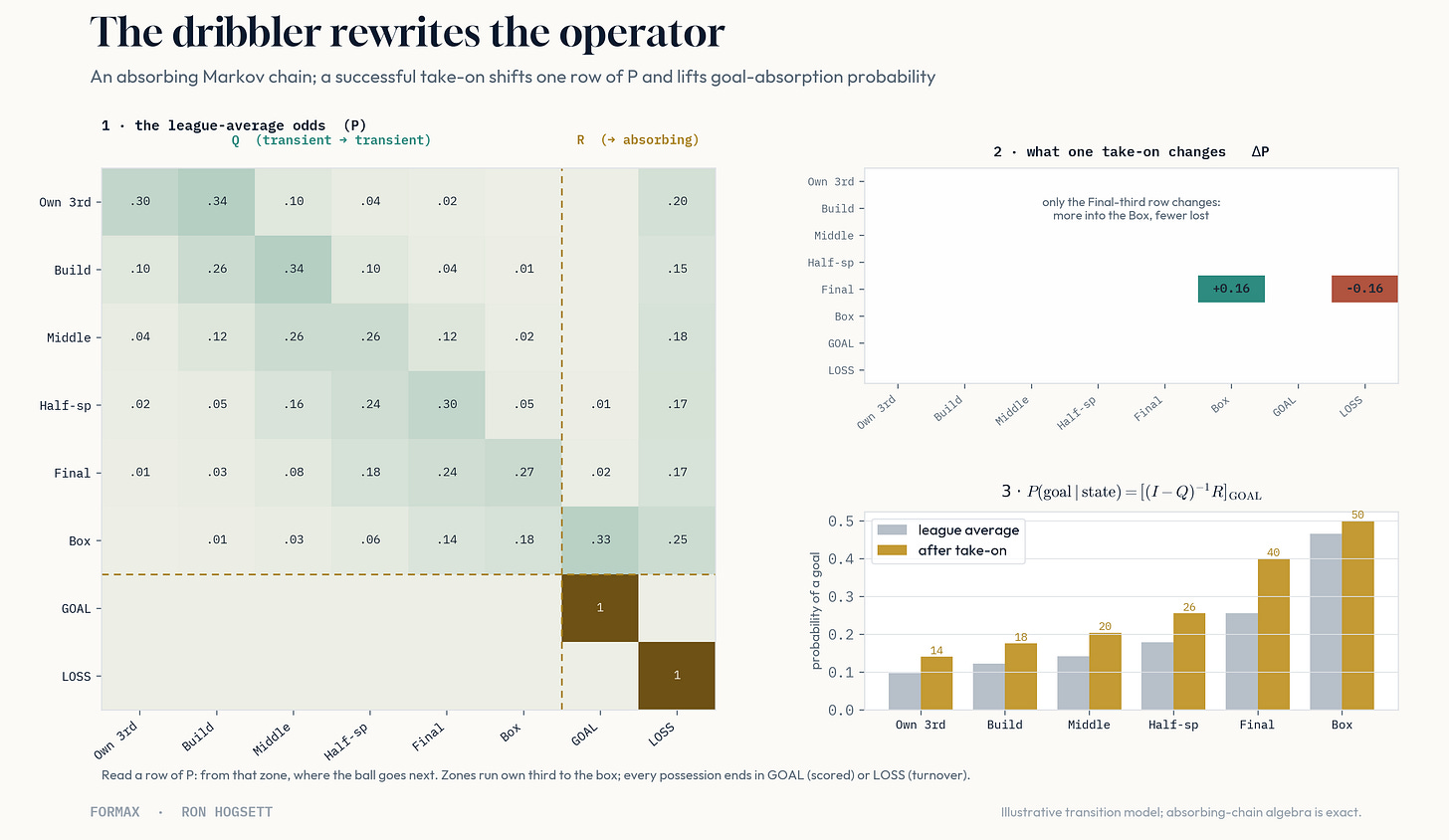
The same possession as bookkeeping. The grid holds the league-average odds of moving between states. One successful take-on shifts a single row, and the chance of an eventual goal rises from every state behind it.
What the data actually says
This is not theory waiting for evidence. The action-valuation models that clubs pay for already price the dribble in goals.
StatsBomb’s On-Ball Value model assigns every action a number equal to its effect on the team’s probability of scoring and conceding, and it deliberately rewards penetrative carries over decorative ones. A dribble that drags the ball from the touchline to the edge of the six-yard box is credited far more heavily than one that ends sideways, because the model is reading the threat surface underneath. The same logic drives VAEP, the framework from Decroos and colleagues that values each action by how much it shifts the team’s short-term chance of scoring and conceding. In their canonical worked example, a player carries past a Real Madrid defender into the box and the take-on alone is valued at plus 0.05 in scoring probability, before anyone has shot.
Look closely at one of these sequences and you find the honest version of the whole argument. In a reconstructed Messi possession, the take-on is valued at roughly plus 0.05. It is not even the largest action in its own sequence. The pass that follows it is worth more, around plus 0.09, and the shot at the end is worth plus 0.83. That is the point, not a problem for it. The take-on did not score, and it was not the biggest number on the page. What it did was manufacture the state in which a plus 0.09 pass and a plus 0.83 shot became available at all. Its worth is not the size of its own number. It is the doors it opens for the numbers after it. This is exactly why the superlative version of the claim is wrong and the state-manufacture version is right.
The aggregate validation is sharper still. When Decroos and colleagues ranked players by total VAEP rather than by goals or assists, the combined market value of their top ten came to 1,110 million euros, against 862 million for the top ten by goals and 947 million for goals plus assists. The transfer market, which is a brutal and well-funded prediction engine, was already paying for the value that on-ball action models capture and that the goals column misses.
End-product data agrees from the opposite direction. Across the seasons Opta studied, the most efficient take-on artist by end product was Edinson Cavani, whose take-ons produced a shot or a created chance 17.3 percent of the time, fifty-three from three hundred and six. Better than one take-on in six turning directly into a scoring threat is an extraordinary conversion rate for the single hardest action to complete against a professional defender. And the newest tracking-based research, the Dynamic Expected Threat model trained on more than three hundred thousand actions, exists precisely because the static league-average chain is known to misprice these moments. Its entire motivation is that a fixed transition matrix cannot see what a specific player does to a specific defensive shape. The field is, in other words, rebuilding the math to capture exactly the effect this essay is about.
The value peaks when everything else has failed
There is one more property of the dribbler that the Markov framing exposes and that should matter most to anyone building a development model. The dribbler’s marginal value is highest exactly when the rest of the system is stuck.
Against a compact low block, the league-average transition matrix flatlines near goal. The passing routes into the box carry near-zero probability because every lane is occupied, which is the whole point of a low block. In that state, almost no passing sequence has a meaningful chance of reaching a dangerous square. The dribble is frequently the only transition left with non-trivial probability into the penalty area. As the analytics writer behind the Elo dribbling work put it, the take-on becomes a game-changer when tactics fail, the crack in the wall when every passing lane is covered. Mathematically, the dribbler supplies access to high-reward absorbing states that are otherwise nearly unreachable. He does not raise the average outcome so much as he fattens the right tail, and the right tail is where the goals against organized defenses live.
This also disposes of the lazy charge that dribblers are inefficient. Efficiency measured as a flat success rate is the wrong statistic. The correct statistic is conditional value: what the action is worth given the state, and given that no safer action had any value to begin with. Judged that way, the take-on against a set defense is not a luxury. It is the only key that fits the lock.
The three superiorities, and which one the dribble manufactures
The Spanish positional school names three kinds of advantage. Numerical superiority is having more bodies than the opponent in a zone. Positional superiority is having better-placed bodies. Qualitative superiority is isolating a better player against a weaker one and letting talent decide. The technical dribbler feeds all three, but he is most directly a qualitative-superiority weapon: get your best one-versus-one player matched against a single defender in space and the duel is yours before it starts. The moment he wins it, qualitative superiority converts into numerical superiority downstream, because the eliminated defender is now a spectator and the next phase is played at plus one. One man beating one man is the engine that produces the two-versus-one everywhere else.
Decision-making cannot choose what technique has not built
Coaches love to rank the attributes. Technique, decision-making, tactical understanding, physical capacity, psychology, laid out like items on a menu, followed by the question of which one matters most. Decision-making usually wins that vote. The vote rests on a category error.
Decision-making and technique are not parallel attributes. A decision is a selection from the set of actions you can actually perform, and that set is written by your technique. You cannot choose to do what you cannot do. The player who cannot beat a man will never decide to beat a man, because the option was never on his menu in the first place. His decision-making did not fail him. The choice was foreclosed before he reached it. Technique is therefore not a sibling of decision-making. It is its precondition. It defines the option space that decision-making then sorts through, and even flawless ordering of a short menu is capped by how short the menu is.
The science of how athletes actually decide says the same thing, only more precisely. The dominant framework for skill and decision-making in sport, ecological dynamics, holds that performance is the coupling of perception and action, channelled by skill and aimed at affordances, which are the opportunities for action the environment offers. The load-bearing word is channelled. You perceive the affordances your skill can exploit and you are effectively blind to the ones it cannot. A technical dribbler who looks at an isolated defender perceives a scoring opportunity. A player without the technique looks at the identical picture and perceives a dead end, because for him the affordance does not exist. Skill is not the thing that executes the decision after the brain has made it. Skill shapes what you perceive, which shapes what you can decide. Decision and execution are not two stations on an assembly line. They are one coupled act, and you cannot amputate the front half and keep it useful.
There is an apparent contradiction here worth resolving directly, because a careful reader will spot it. If perception and action are coupled, how can technique be the precondition of decision-making rather than merely its partner? The answer is that coupling and developmental order are different things. In the moment of play, perception and action are genuinely reciprocal and refine each other continuously. But in development they are asymmetric. You cannot perceive an affordance for an action you have never been able to perform, so the capability has to be seeded before the perception of it can exist. The coupling is real in execution. The order is one-way in development. Technique is the precondition not because it outranks decision-making in a live match, but because it is the thing that has to exist first for the decision to become available at all.
So why do serious coaches keep insisting decision-making is the great differentiator? Because at the top of the game they are correct, and the reason they are correct is the entire point. At elite level technique is universal. Everyone in that dressing room cleared the execution bar a decade ago, so the only variance left to separate them is choosing well under time and pressure. That is a true observation about a filtered population, and it is the strongest evidence imaginable for the developmental claim, not against it. Decision-making becomes decisive precisely because execution has already been mastered by everyone present. You only get to hold the “it is all about decisions now” conversation inside a room where execution is assumed. The players winning on decisions are survivors of a technical filter that was applied to them years earlier. Mistaking that last differentiator for the first priority is exactly how an academy produces thoughtful players who cannot do anything.
This is why beating a man sits high on the value table and at the bottom of the development order at the same time. It is among the most valuable actions a player can choose, and it is the only one that rebuilds a state the defense had taken away, and it is unavailable as a choice to anyone who has not first been built to execute it. No quantity of decision-making rescues a player from a menu that does not contain the winning option.
The objections worth taking seriously
A thesis is only as strong as the best argument against it, so here are the three that matter. The first two miss. The third is real, and answering it is where the argument actually gets built.
The first is the data objection. There is research finding that possession-based central play correlates with winning while individual actions such as dribbling do not, which sounds fatal until you read what it actually measures. Those are team-level, style-level correlations against match outcome, and they count dribble volume rather than dribble value. That is exactly the error that On-Ball Value and VAEP were built to correct. Counting how often a team dribbles tells you almost nothing, because a trailing team chasing a game dribbles out of desperation while a dominant team keeps the ball and wins, so the correlation is contaminated by who was already ahead. My claim is not about volume or team style. It is about the marginal value of one successful elimination, and on that measure the value models are not ambiguous. None of this is an argument against possession football. A possession team and a team built around eliminators are not enemies. The eliminator is the answer to the one problem possession cannot solve on its own, which is the organized defense that refuses to be passed through.
The second is the cherry-picking objection. Messi and Cavani are convenient examples. They are, which is precisely why the load-bearing evidence is not them. It is the aggregate result that the players who rank highest by total on-ball value command a combined market value well above the players who rank highest by goals or by assists. The transfer market, spending real money across entire populations of players, already prices the action this essay is about. The exemplars illustrate the mechanism. The aggregate proves it is not just a handful of geniuses.
The third is the risk objection, and it is the one that matters. Dribbling is high variance, you are ignoring the turnovers. I am not, and answering this properly is what turns the essay from a celebration of dribbling into an argument about how to build players. Start with the honest accounting. The value models already net the loss out. A failed take-on is penalized in both OBV and VAEP according to the danger it hands the opponent, so the figures cited here are net of failure, not gross. But the real answer is not defensive at all. The right unit was never the value of a completed dribble, it was the expected value of an attempted one, and expected value is a function of skill. The same attempt that is reckless for one player is correct for another, because the probability of success is different. Which means risk is not a fixed property of the action. It is a moving property of the player, and moving it is the entire job of development. That is the spine of the argument, and it is where the essay goes next.
What this means for how you build players
A take-on is not a thing you choose to complete. It is a thing you choose to attempt, and the attempt is governed by expected value: the probability of beating the man, times the value of beating him, minus the probability of losing it, times the cost of the turnover. That one equation reorganizes the entire development question. For a young player whose probability of success is low, the expected value of attempting a take-on against a real defender is often negative, which is exactly why forcing the decision early is a mistake. The action is not yet rational for him, and no amount of tactical instruction makes it rational, because the term that is failing is not his judgment. It is his probability of success.
Now look at what training actually does to that equation. It moves one term, and it moves it hard. Coaching raises the probability of success. The value of a successful elimination is large and the cost of a failed one is roughly fixed, so lifting the success probability is the lever that flips the expected value of the attempt from negative to positive. That is the whole game. Development is not teaching a player when to dribble. Development is changing the expected value that the decision is made over, until the point where attempting the elimination is simply the correct call. You train until beating a man becomes rational, and then the decision takes care of itself.
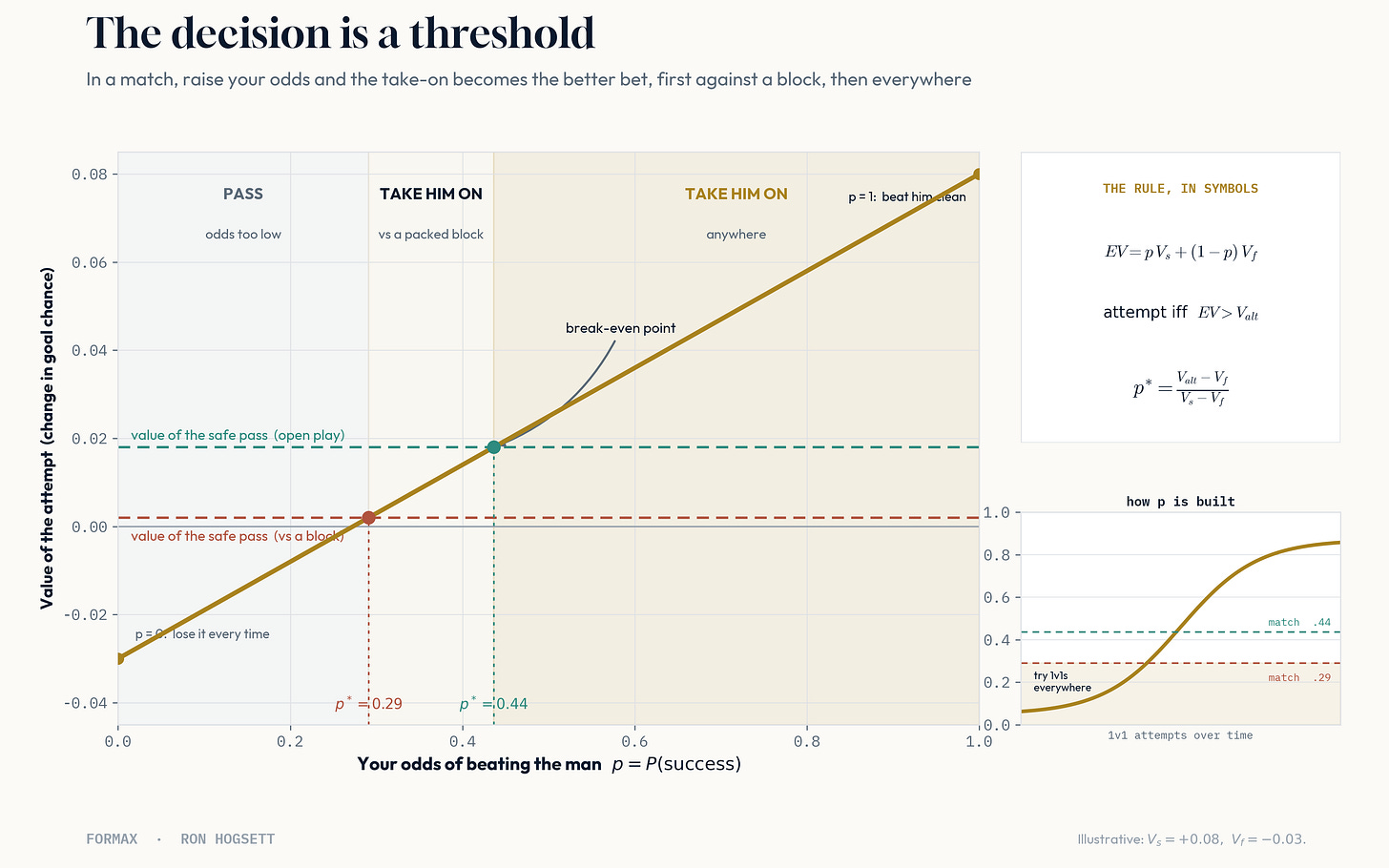
The in-match choice is a bet: attempt when the odds clear the break-even, which falls against a packed defense. In development the cost of failure is near zero, so the gate drops away: young players try 1v1s everywhere, and the attempts are what build the odds.
This is why the technique has to be built early and built deep. Master the one-versus-one, the close control, the manipulation of the defender’s balance and posture, in the years when a lost ball costs nothing competitive, because those are the years you can push the success probability up the steep part of the curve. The tracking research is blunt about what actually decides these duels: the defender’s posture, the attacker’s relative speed advantage at the moment of attack, and the space to work in. Those are trainable, and they are trainable best before tactical accounting starts charging rent on every touch. Do it in the right window and by the time the game demands the decision, the odds of pulling it off are already high enough that the decision is not even close.
The mathematics and the methodology meet in the same place. The probability models say defender elimination is where threat is manufactured and where organized defenses are genuinely broken. The expected-value logic says the attempt only becomes worth making once skill has lifted the odds of completing it. The development model says that skill has to be built before any of it can be deployed. Put together they make one instruction that is hard to dodge. Raise the success probability early, because it is the only thing that turns the most state-changing action in the game from a gamble into a decision.
The dribbler is not the token the model pushes around the board. He is the hand that moves the pieces and bends the odds while doing it. Build hands, and build the odds.
Sources
- Karun Singh, “Introducing Expected Threat (xT),” 2018. karun.in/blog/expected-threat.html
- Sarah Rudd, “A Framework for Tactical Analysis and Individual Offensive Production Assessment in Soccer Using Markov Chains,” NESSIS, 2011.
- Tom Decroos, Lotte Bransen, Jan Van Haaren, Jesse Davis, “Actions Speak Louder than Goals: Valuing Player Actions in Soccer,” ACM SIGKDD, 2019. arXiv:1802.07127
- StatsBomb / Hudl, “Introducing On-Ball Value (OBV).” statsbomb.com
- Opta Analyst, “The Definitive Guide to Dribblers.” theanalyst.com
- “Dynamic Expected Threat (DxT) Model,” Applied Sciences (MDPI), 2025.
- Fernández, Bornn, Cervone, “Decomposing the Immeasurable Sport: A Deep Learning Expected Possession Value Framework for Soccer,” MIT Sloan, 2019.
- “What Makes a Dribble Successful? Insights From 3D Pose Tracking Data,” arXiv:2506.22503, 2025.
- James J. Gibson, “The Ecological Approach to Visual Perception,” 1979.
- Duarte Araújo, Keith Davids, et al., “The Ecological Dynamics of Decision Making in Sport,” Psychology of Sport and Exercise, 2006; and “The Ecological Dynamics of Cognizant Action in Sport,” 2025.