The United States did not lose to Belgium because American soccer lacks effort, athletes, resources, facilities, or ambition. Those explanations are too easy and too emotional.
The United States lost 4-1 because Belgium exposed the difference between being organized and being functionally superior.
Thanks for reading! Subscribe for free to receive new posts and support my work.
I have spent thirteen years building players from the foundation up, first in Dallas and now on two continents, and I have watched this exact failure repeat at every level of the American game. What happened in Seattle was not a bad night. It was the national version of something I see on youth fields every weekend.
The U.S. now produces players who compete. Players who run, press, cover ground, play in Europe, understand roles, and execute game plans. That is real progress. But against elite international teams, the game is no longer decided by whether a team can participate in modern football. It is decided by whether its players can solve modern football at speed, under pressure, with minimal cognitive load, and with enough technical authority to impose themselves when the opponent removes the obvious answers.
Against Belgium, the answer was no.
#### What Actually Happened in Seattle
The public reaction centered on the familiar list: defensive mistakes, the Freese error, emotional collapse, tactical naivety. Pochettino called it “not our day.” Those observations are valid, but they are also symptoms, not the disease.
Consider what Belgium actually did, because it is more damning than the scoreline.
Rudi Garcia did not start Romelu Lukaku. He did not start Jeremy Doku. Kevin De Bruyne never entered the match at all. Belgium withheld three of its most dangerous players and still won 4-1, because Garcia did not set out to overpower the American press. He set out to solve it. He organized his team specifically to frustrate the pressing structure that has become the USMNT’s identity, invited the intensity, and played through it.
The numbers tell the rest. Belgium finished with an expected goals advantage of 2.15 to 0.67. Charles De Ketelaere scored in the ninth minute. The United States did not register a shot until Malik Tillman’s deflected free kick around the half-hour mark. The host nation, at home, with a full building behind it, produced almost nothing on the ball for ninety minutes.
Matt Freese’s error gifted the third goal, and it received most of the attention. But the error was not isolated from the match context. Elite teams break you by increasing the number of high-stress actions until someone fails. Errors of that kind are rarely spontaneous. They are extracted, drawn out of a team over an hour of accumulating strain, and Belgium had been extracting all afternoon.
This is the pattern that matters. Once Belgium solved the first layer of pressure, the American midfield had to cover too much space. The back line became exposed. Defensive recovery actions multiplied. Individual failure became statistically inevitable.
I would not analyze this as bad defending, that’s too basic. The real issue is that the U.S. could not control the game with the ball long enough to reduce defensive exposure. The best teams defend partly by keeping possession with purpose. They rest with the ball, they control rhythm with the ball, they slow the opponent emotionally by refusing to give the game back.
The U.S. still meets elite opposition in survival rhythm, and survival is not an identity. It is what remains when identity has been stripped away. A team can be admired for surviving, but it cannot build from there, because surviving is a ceiling mistaken for a foundation.
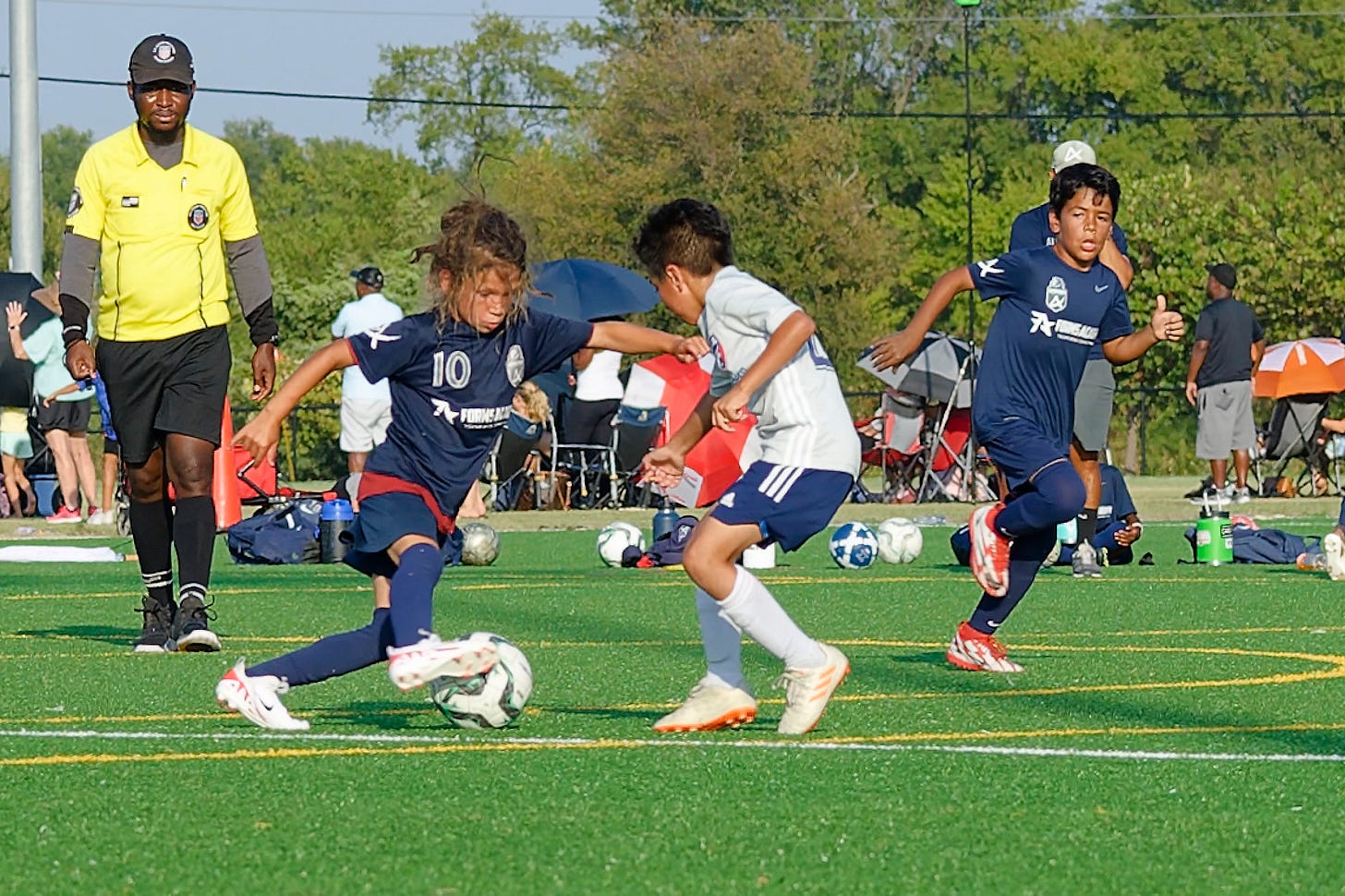
#### The Central Diagnosis
My diagnosis is straightforward:
The United States has closed the athletic, organizational, and professionalization gaps. It has not closed the functional technical gap, and the functional technical gap is the one that decides elite knockout matches.
The functional technical gap is not about whether a player can dribble, pass, shoot, or receive in isolation. Many American players can. The issue is whether those abilities survive under elite pressure, at elite speed, with elite consequence.
At the highest level, a player does not receive the ball into comfort. He receives it into chaos. Pressure arrives before the ball settles. Passing lanes open and close in fractions of a second. Body orientation determines whether the next action exists before the first touch is made. The player must scan, decide, receive, and execute inside a shrinking window.
This is where the United States still breaks. The first touch is slightly loose. The receiving angle is slightly wrong. The scan is late. The decisions are safe instead of progressive. The player needs one extra touch. The opponent needs none. Over ninety minutes that difference compounds until the match looks like a tactical failure or a mentality failure.
But the root is technical automaticity. A tactical idea is only as strong as the technical floor of the players executing it. You cannot press at an elite level if your players cannot secure the ball after regaining it. You cannot build from the back if your defenders cannot receive under pressure. You cannot dominate midfield if your midfielders need too many touches to orient. You cannot be tactically flexible if your players are technically rigid.
Belgium proved this in the most humiliating way available: with a withheld lineup and a game plan built entirely around the assumption that American players could not solve pressure individually. Garcia bet the match on it. He wasn’t wrong.
#### The Three Stages of Technique
At Forms Academy, we separate technical development into three stages. This framework sits at the core of our FORMAX methodology, and it is the lens through which the Belgium match should be read.
Elementary technical ability is the capacity to perform an action in controlled conditions. The player can pass, receive, dribble, turn, shoot. Necessary, but nowhere near sufficient.
Dynamic technical ability is the capacity to perform those actions with movement, speed variation, opposition, changing angles, and realistic tempo. The player begins adapting technique to unstable environments.
Functional technical ability is the automatic, subconscious, low-cognitive-load expression of technique inside the game itself. Technique is no longer a separate skill. It has fused with perception and decision-making. The player receives while scanning, disguises while dribbling, passes while being closed down, changes rhythm under contact, and executes without mentally separating the ball from the problem.
The United States has many elementary technical players in elite youth leagues and admittedly, it has more dynamic technical players on the USMNT than ever before. But against the best nations, the shortage of functionally technical players becomes obvious. Belgium simply had more players who could solve the moment without needing the game to become comfortable first.
That is the gap.
Why “Soccer IQ” Is Misdiagnosed
American soccer loves the phrase “soccer IQ,” and uses it lazily. A player makes a bad decision and lacks IQ. A player plays backward and lacks bravery. A player fails to break pressure and lacks vision. Sometimes true. But often the decision is downstream of technical limitation.
A player who cannot receive on the half-turn will not see the forward option, because his body shape already removed it. A player who does not trust his first touch, even subconsciously, scans less because he is visually tied to the ball. A player who cannot protect the ball under contact chooses the safe pass earlier. A player who cannot beat the first defender never attracts the second one, and so never creates the superior decision.
All of these players fail to produce superiority. And superiority is the currency of football.
Think of a match as a chain of states. Every moment on the pitch is a state: equality, inferiority, or superiority somewhere on the field. Every action is a transition from one state to the next. The quality of a team is not its formation or its game plan. It is the probability that its players can move the game from a neutral state into a superior one, over and over, under pressure.
Those probabilities are set at the atomic level of the game: one player, one ball, one opponent, one moment. A player who receives on the half-turn converts a neutral state into a forward-facing one. A player who beats his man converts equality into superiority and forces the entire opposing structure to reorganize. A player who cannot do these things does not merely fail in that moment. He deletes entire branches of the game. The superior states still exist in theory. His team can no longer reach them. Now multiply that reality across every non-functionally technical player on the field.
This is the real American disadvantage, and it is worse than a bad starting position. A bad starting position can be recovered from. Our problem is the transition probabilities themselves. Without enough functionally technical players, every state we occupy carries worse odds of improving and better odds of degrading, no matter how modern the structure looks, and no matter how much progress we have made in every other aspect of the sport.
Many will say the issue is intelligence. It’s not, the issue is available intelligence.
The brain is the operating system of the player, and the operating system cannot allocate itself to higher-order football problems while basic technical actions remain unstable. A technically insecure player becomes cognitively overloaded. A cognitively overloaded player becomes tactically predictable. A tactically predictable player is exactly what Garcia built his game plan to exploit.
At the highest level, intelligence and technique are inseparable. Sovereignty at the atomic level sets the odds of every state that follows. Everything downstream, including everything that happened in Seattle, is just the math playing out.
#### The American Development Mistake
The American system rushes children into tactical obedience before they have technical autonomy. This is the most damaging developmental habit in the country, and I have built an entire school around refusing to participate in it.
At U8 through U12, coaches are rewarded for making children look organized. Parents see shape, passing patterns, and winning results, and assume development is happening. Clubs market structure as sophistication. Adult tactical architecture is installed onto children whose technical base is still fragile.
The team looks advanced and organized, but the player may not be developing. That’s the trade, but understanding the consequences of the trade will not be visible until it’s too late, and it only costs the player his or her future in the sport.
The problem is not tactics. Tactics are essential. The problem is premature tactical dependence. When tactics arrive before technical autonomy, the system does the thinking for the child. The coach solves the game. The formation solves the spacing. The pattern solves the next pass. The child learns where to stand and when to release the ball, but not how to solve pressure.
This produces players who function inside rehearsed structure and struggle when elite opponents destroy said structure, which is precisely what elite opponents do. Belgium did not allow the U.S. to live inside its idealized training pictures. They altered the pressure, changed the rhythm, forced awkward receiving angles, and made American players solve problems that were not clean.
The American system must ask itself a hard question: are we producing players who understand instructions, or players who can generate solutions? Those are not the same thing.
#### The Missing Player Type
The missing profile in American soccer is not the athlete, nor is it the disciplined role player. It is the functionally technical problem-solver: the player who does not merely have technique but has technique that remains available under pressure, who does not merely know tactics but interprets tactical problems in real time, who does not merely follow instructions but creates new solutions when the pattern collapses.
America needs more of the kids who get yelled at for being selfish. Every club in the country has one: the boy who takes on three defenders when the easy pass is open, who tries the same move he failed with two minutes ago, who hears the sideline groan and goes again anyway. I describe that child differently. He loves the ball, and he is in the middle of finding out what is possible with it. That is the mindset that produces the best players in the world, the way a child plays before anyone has taught him he can lose. And we treat it like a discipline problem. We coach it out of him by ten, praise the safe pass by twelve, and then wonder why no American could beat a man in Seattle. These players must be identified and protected, and protecting them means admitting that imposing adult judgment on a child’s instincts is precisely what keeps setting us back. We say we love this game. Then we must love it enough to let them fail, again and again, until their love for it carries them somewhere the rest of us, under the existing paradigm, never went.
Post-match analysis converged on the same missing qualities under different names: press resistance, composure, 1v1 elimination, midfield control, flexible problem-solving. Strip away the vocabulary and the theme is singular. The U.S. lacks enough players who can change the game individually without breaking the collective structure.
That is the modern elite requirement. The best teams do not choose between structure and individuality. Their structure creates the conditions for individual superiority, and their individual superiority protects the structure when the pattern fails. American soccer still frames this as a debate between two camps. One side wants structure, pressing, and role clarity. The other wants creativity, dribbling, and expression. I reject that split entirely. The best player is neither a freestyle artist detached from the game nor a robotic tactical soldier. The best player is functionally expressive: enough technical mastery to create, enough tactical intelligence to choose, enough cognitive stability to execute under stress.
The United States now produces many good players, and that is a trap of its own. Good players survive professional environments, play in Europe, press, run, and compete. But elite knockout matches are not won by eleven good players. They are won by having enough players who tilt the field. A field-tilting player eliminates defenders, receives in pressure and turns, attracts multiple opponents without losing the ball, breaks lines with disguise, and gives the team control when the match becomes unstable.
Pulisic has elements of this. Reyna, when healthy and trusted, has elements of this. Balogun brings vertical threat and finishing. But as a collective, the U.S. still lacks field-tilting profiles in enough zones. Belgium had more players who could turn individual quality into collective advantage, and it kept three of its best in reserve.
#### The Forms Prescription
The solution is not more games, more academies, more MLS investment, or more European moves. Those things help. They do not fix the problem. The United States needs a developmental reordering, and at Forms we build it on five pillars.
Pillar One: Technical Supremacy. Technique is the operating system of the player, and it must be built before tactical dependence, not after. Young players must spend their most sensitive developmental years mastering the ball, the body, rhythm, deception, receiving, turning, and execution under increasingly complex constraints. The target is not tricks. The target is control, manipulation, precision, and adaptability that remain reliable under pressure. It is what a player believes is possible when no one has ever told him no. At young ages the priority is not producing a well-organized youth team. It is producing players who can eventually make any team better.
Pillar Two: Cognitive Freedom. The purpose of technical development is not cosmetic smoothness. The objective is cognitive liberation. A player under pressure has limited attentional bandwidth. If that bandwidth is consumed by controlling the ball and managing balance, the player cannot perceive, anticipate, or deceive. The more automatic the technique, the more available the brain. This is also why perception must be trained with technique, never separately from it. Scanning is worthless if the body and ball cannot act on what the brain sees. The player must receive with information, decide before the ball arrives, and shape his body around the next action. Elite players are not faster because they run faster. They are faster because the next action is already forming before the opponent understands the current one.
Pillar Three: Functional Creativity. Creativity is not random freedom. It is the ability to produce effective, unexpected solutions inside the game’s constraints. Central to this is 1v1 elimination, which should be a national development priority. Modern football is compact. Spaces are small. If no one can beat a man, the attack becomes dependent on perfect passing patterns, which elite defenses are built to absorb. Beating one defender turns equality into superiority, forces cover, opens the next pass, and changes the opponent’s emotional state. American soccer still suppresses this too early in the name of playing the right way. That is a mistake, and Belgium’s game plan was a ninety-minute demonstration of its cost.
Pillar Four: Pressure Fidelity. Technique that never enters pressure never becomes functional. This is not an argument against cone work or unopposed training. Unopposed work is where the foundation gets poured: coordination, proprioception, motor patterning, and eventually dual-task automaticity, where the feet execute while the mind is loaded with something else. The problem is not the drill. The problem is the absence of a system behind it. The same cone pattern can be a deliberate layer inside a progression, or it can be choreography copied from a screen, and from the sideline the two are indistinguishable. The difference is invisible: whether anyone knows what the drill is for, what it is building toward, and when the player has outgrown it. Most American training cannot answer those three questions. From the foundation, training must progressively load time pressure, spatial pressure, physical contact, emotional pressure, and cognitive interference, because the question is never whether the player looks good in the drill. It is whether the player preserves quality when the drill becomes the match. Too much American training is either too clean to transfer or too chaotic to teach. The art is designing environments that preserve technical focus while raising functional pressure, one deliberate layer at a time.
The most important of those layers is small-sided play. The logic is arithmetic before it is philosophy: a child in a 3v3 touches the ball, faces a duel, and makes a real decision many times more often than the same child parked inside an eleven-a-side formation. Compress the game and you multiply the moments that build a player. Nowhere is that compression more complete than futsal. The smaller, heavier ball punishes poor technique, the hard surface quickens everything, and the shortage of space means pressure arrives on every possession rather than occasionally. There is no hiding place on a futsal court, and that is precisely its value. The countries that produce the most functionally technical players in the world did not discover this recently; they raised generations of them on those courts. Small-sided football is where 1v1 courage, tight-space receiving, and rapid perception stop being drill outcomes and start becoming the player’s nature. Any prescription for the American player that does not run through the small-sided game is incomplete.
Pillar Five: Long-Term Player Formation. The goal is the player at sixteen, eighteen, and twenty-one, not the weekend result. This demands the most difficult cultural change of all: parents, clubs, and directors must stop rewarding youth coaches for adult-looking teams. A U10 team that wins through structure, athleticism, and rehearsed patterns may be producing players who will be exposed later. The question should not be whether the team looks organized. It should be whether the players are becoming more capable. Can they receive under pressure? Solve without instruction? Eliminate? Disguise? Play when the game becomes messy? If not, the development is incomplete. I would rather produce a player who can dominate the ball at fourteen than a U10 team that wins because it was over-coached. That is the trade most clubs are unwilling to make.
We make it every day.
#### What the Belgium Loss Should Teach America
The lesson is not that the U.S. is hopeless, but this should not be considered a “future looks bright” moment. Truth is, the next gap is harder.
The first stage of American soccer growth was participation. The second was soccer-specific athletic competitiveness. The third was professionalization. The fourth was exporting players. The fifth must be functional mastery.
The country has enough players to compete. It does not yet have enough players to control elite matches. It has enough structure to look modern. It does not yet have enough technical authority to impose itself when the game becomes uncomfortable.
The goal should not be catching up to elite nations by copying their current senior-team tactics. Every youth coach must understand this: copying is a non-starter for development, and it leaves the senior team permanently a step behind. The goal should be building a better developmental model, and here America holds a genuine advantage it rarely recognizes. The U.S. does not carry centuries of football tradition. Tradition protects wisdom, but it also protects bad habits. Viewed the right way, that absence is a real opportunity. America can build something more intentional: skill acquisition science, neuroscience, ecological dynamics, constraints-led training, futsal principles, and modern tactical education combined into a new developmental architecture.
But that requires courage. It requires clubs to stop selling short-term wins, parents to stop chasing badges, coaches to stop confusing control with development, and a national willingness to say plainly: we are not producing enough players who can dominate elite pressure, and we need to change how we build them.
This is not pessimism. This should be the beginning of progress.
#### Final Position
The U.S. does not need to become more European in appearance. It needs to become more serious in formation. The answer is not copying Belgium’s shape, Spain’s rotations, France’s athleticism, or Brazil’s flair. The answer is understanding the developmental principles beneath those expressions: deep contact with the ball, intelligent pressure, creative exploration, tactical context, and years of environments that demand solutions.
The country must stop asking how to make its teams look more advanced and start asking how to make its players more capable, then more portable, then more functional.
I built Forms Academy inside that shift, and everything we do, from our first sessions with four-year-olds to our partnership pathway with FC Dallas, is organized around one conviction: the next American breakthrough will not come from better slogans, better showcases, or more tactical diagrams. It will come from producing players who are functionally technical, cognitively advanced, creatively decisive, and capable of imposing themselves against the best players in the world. In short, creating players who are functionally technical, portable, and adaptable.
The Belgium match can be read as humiliation or as ignition, and both are fair. But before it is either of those, it is evidence. The gap is visible, the diagnosis is clear, and more importantly, the prescription is available. Again, this is not a “future looks bright” moment, this is an “enough is enough” opportunity, if we take it.
Now American soccer has to decide whether it wants to keep producing organized competitors or begin producing superior footballers.
Forms chose the second path a long time ago.
Join us.
Ron Hogsett
Forms Academy | Forms Residency | Forms Madrid
Thanks for reading! Subscribe for free to receive new posts and support my work.