World Cup Final · Spain v Argentina · MetLife Stadium · 19 July 2026
Eleven days ago, my model gave Spain 56% against France while the public consensus leaned the other way. Spain won, and the mechanism was exactly the one the model saw. Four days later it gave Argentina 56 against England, again against the lean of the consensus. Argentina won. Two calls, two correct, both published before kickoff at forms-markov.netlify.app, where they remain, timestamped, next to the misses the model has made and will make again.
Tonight the model says Spain lifts the World Cup at 63%, and for the first time this tournament the consensus broadly agrees with me. So this piece is not about the number. It is about what the number is made of. Because this final is a collision between the two most extreme relationships with reality I have ever measured in this sport, and once you see it, you will not be able to watch the match any other way.
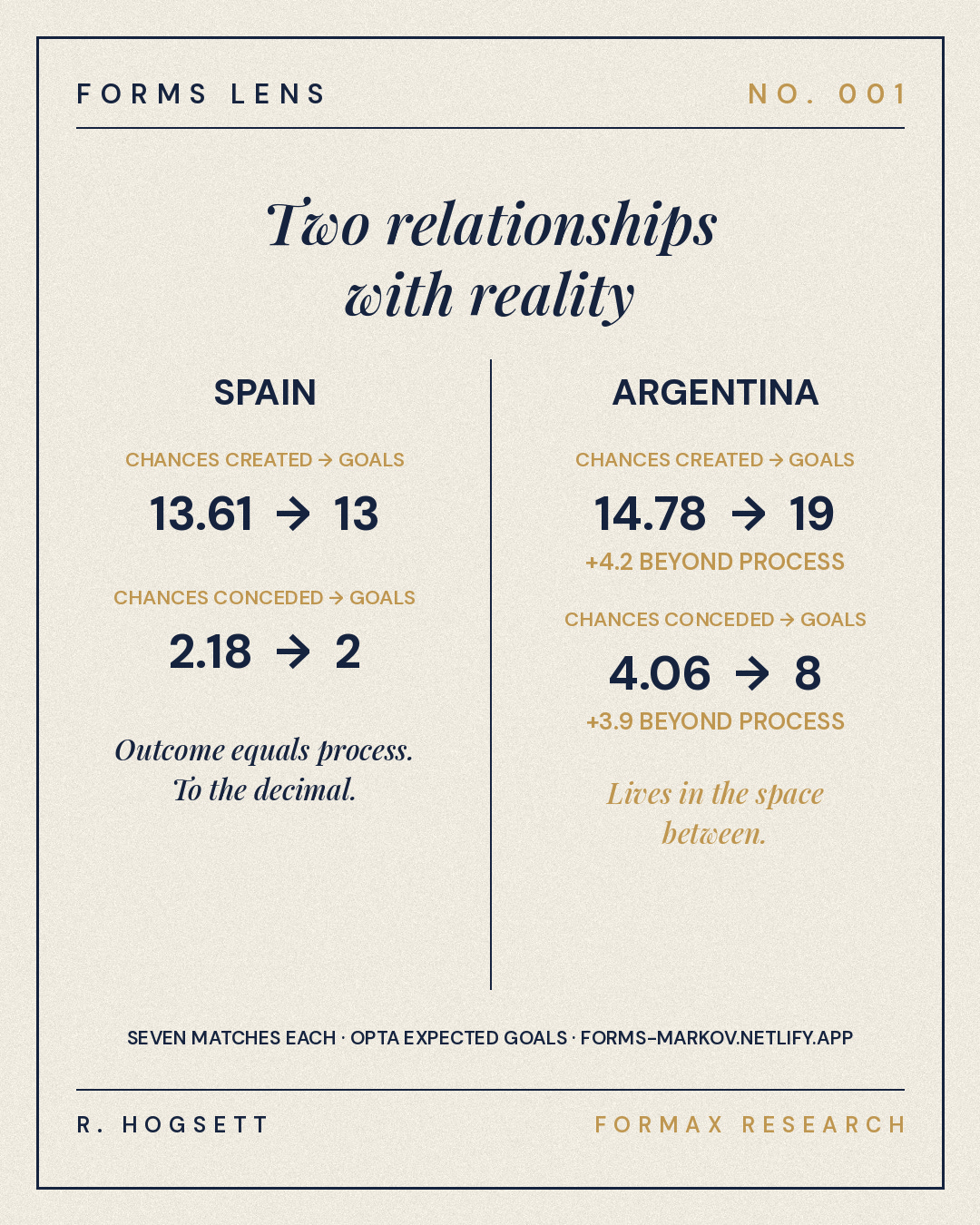
Every team has two stories: what it does (the chances it creates and allows) and what it gets (the goals that actually go in). When those two stories match, the team is its process, no luck, no noise, just who they are, repeated every match. That’s a fingerprint. Spain has created chances worth 13.61 goals this tournament and scored 13. Conceded chances worth 2.18 and allowed 2. What Spain does is what Spain gets, to the decimal.The Gap. When the two stories don’t match, the team is living in the space between them. Argentina’s chances were worth about 15 goals, they scored 19. Their defending should have cost about 4, they’ve allowed 8. They score more than they build and concede more than they should, and they’ve won anyway, seven straight times, because the first gap keeps outrunning the second.Why it matters tonight: fingerprints repeat. Gaps eventually close, the numbers catch up, usually without warning. The final asks one question: is Argentina’s gap a genuine skill the stats can’t see, or a loan that comes due at the worst possible moment?
I. Spain, or outcome equals process
Add up Spain’s seven matches. Chances created: 13.61 expected goals. Goals scored: 13. Chances conceded: 2.18 expected goals. Goals allowed: 2.
Across an entire World Cup, Spain’s results match Spain’s process to the decimal, at both ends of the pitch. There is no luck anywhere in their tournament, in either direction. I have spent the last two weeks measuring how rarely that is true of any football team in any competition, and I have not found another one like this. Spain is not having a good tournament. Spain is a process wearing a kit, and the process has simply been left unbothered for seven matches.
The defensive half is the outlier of the tournament: 0.31 expected goals conceded per match. France arrived in the semifinal averaging 2.33 per game and left with 0.30. Spain does not survive attacks. Spain prevents them from being born.
And the attacking half contains the sentence I want you to keep. In that semifinal, both teams took exactly ten shots. Spain’s ten were worth 1.63 expected goals. France’s ten were worth 0.30. Identical volume. Five times the value per act. Spain does not beat you by doing more. Spain beats you by making the same action worth five times as much. That is what a constructed arrival is, and it is the most misunderstood thing in football.
II. Argentina, or the gap
Now the champions. Chances created: 14.78 expected goals. Goals scored: 19. Five beyond what the process produced. Chances conceded: 4.06. Goals allowed: 8. Four beyond what the process should have cost.
Argentina overperforms in attack and underperforms in defense, simultaneously, and wins anyway, because the first gap has outrun the second for seven consecutive matches. Two of those wins needed extra time. Every knockout was decided by one goal, late. Argentina is not living on its process. Argentina is living in the space between its process and its results, which is the most dangerous position in analyzing football, and they’ve created success off this gap 7 times in a row. To be clear, the data struggles to account for the impact of a player like Messi because his ability, like magic, is impossible to quantify for now. This gap can only be attributed to Messi; let’s see how much magic he has left.
Be precise about what this gap is, because it is easy to misread. Argentina has won the chance battle in every single match. Their variance does not live in their results. It lives in their conversion, five goals beyond their chances at one end, four beyond their concessions at the other. A team that wins the process and outruns it at the same time is either a champion twice over or a correction waiting to happen, but it’s one or the other.
III. The case for Argentina, at full strength
The consensus gives Argentina 26% in the ninety minutes. I give 16%. Those ten points have names: Messi in a final, finishing craft that expected goals systematically undervalues, a champion’s tolerance for suffering that no chance model can see. These are real things, and anyone who tells you they are not has never watched Argentina close out a knockout match.
Here is what 20 years of league data says about them: finishing overperformance is the least persistent skill football produces. Gaps like Argentina’s close, and they close without warning. Here is what the same data also says: they do not have to close tonight. One match is one draw from the deck. The 16% is not a zero, and Argentina, of course, has Messi.
IV. What to watch, not who
Ignore possession. Ignore the scoreline until late. Watch two mechanisms.
Spain’s constructed arrivals: the rate at which the ball enters Argentina’s box through built play. If that count climbs at Spain’s normal rhythm, the fingerprint is holding and the 63% is intact regardless of what the score says at the hour.
Argentina’s first great chance: not whether it comes, but what happens to it. Their tournament says it becomes a goal at a rate the process cannot explain. If it arrives and dies, the gap has begun to close at the worst possible moment in football history to be owed a correction.
The scoreline will update all night and tell you almost nothing. These two numbers will tell you which team’s version of reality is winning.
V. The number
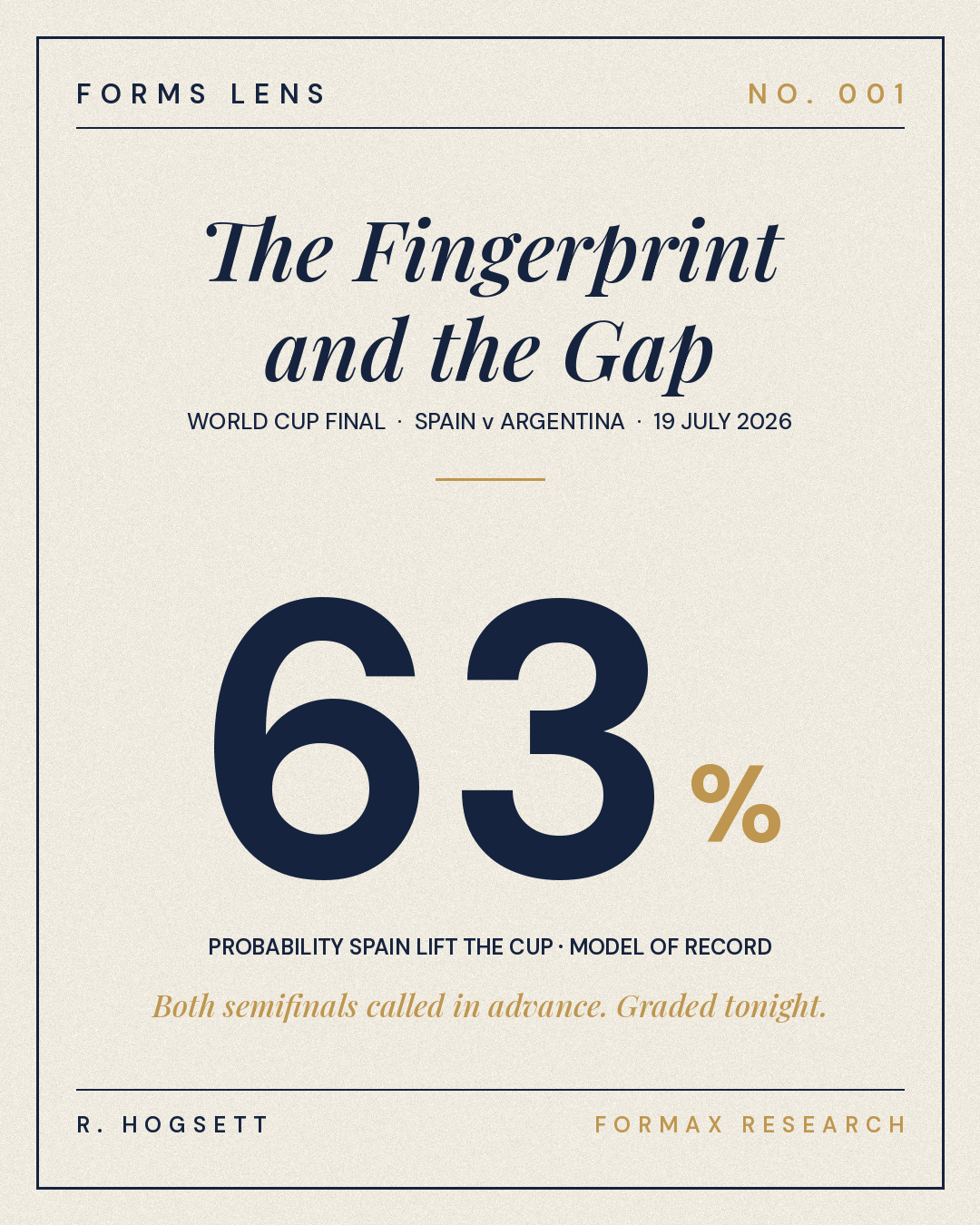
Spain 43%, draw 41%, Argentina 16% in 90 minutes. Spain 63% to lift the cup. Written down before kickoff, like the semifinals were. Graded tonight in the same font, hit or miss. The scoreline tonight will be a fact. The mechanism will be the truth. I will report both.
Method: expected goals for all 102 tournament matches from Opta figures as published in match reports. Model: time-decayed Dixon-Coles on xG, refit through the semifinals, parameters and backtest public at forms-markov.netlify.app. Consensus figures: aggregate of public forecasts and prediction platforms, July 16-18. Graded July 19.
FORMAX Research is the analytics arm of Forms Academy, a Cognia-accredited K-12 school and player development program in North Texas and Madrid. We study the professional game to understand what technical development is worth.
R. HOGSETT · FORMAX RESEARCH