Ferran Torres, 106th minute, back of the net, 37 seconds into the second period of extra time. Spain are world champions. Yesterday morning, well before kickoff, I published a number and a mechanism. Last night, both were graded by the only examiner that counts, and I am going to show you exactly how the match confirmed, phase by phase, a piece of analysis that was written and timestamped hours before the event it described.
I am going to step outside my comfort zone, and I am not going to be modest about it. There is no version of what comes next that survives modesty, so let me be precise instead, because precision is the only thing that earns a claim this large.
Thanks for reading! Subscribe for free to receive new posts and support my work.
The number
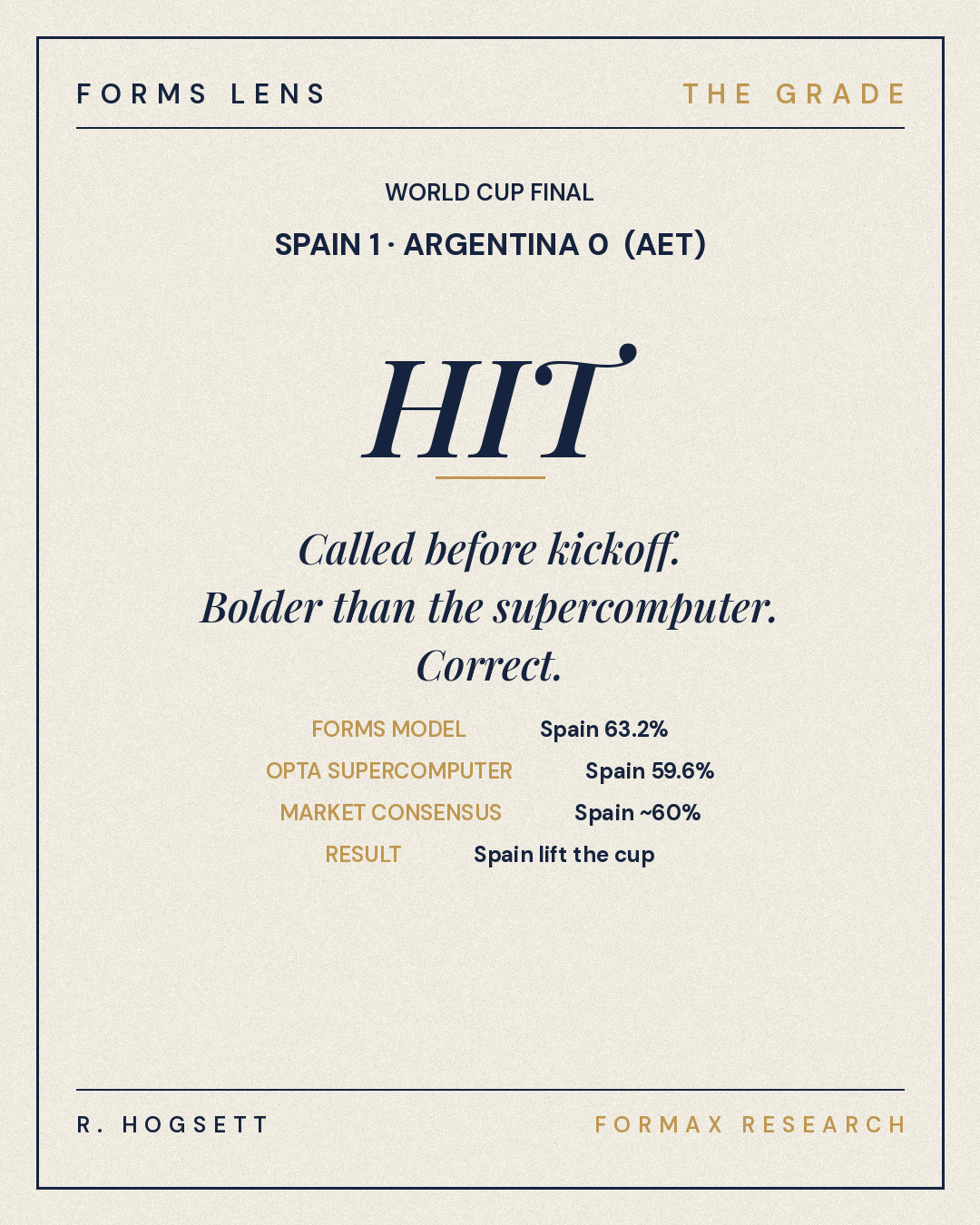
I gave Spain 63.2% to lift the cup. The Opta supercomputer, the most-cited forecasting model in the sport, gave Spain a 59.6%. The betting consensus sat near 60%. My number was not the crowd’s number; it was three and a half points bolder than the machine, in the same direction, and it was correct.
I also split the 90 minutes into Spain 43,% draw 41%, Argentina 16%, and I wrote in the preview that the 41% regulation draw was the largest draw branch the model had ever printed. The match went to extra time at 0-0. The single most emphasized structural feature of the forecast, the thing I flagged in writing as unusual, is the thing that happened. Regulation produced the draw the model saw more clearly than it had ever seen, and extra time produced the Spanish win the headline demanded. Both branches, in sequence, as written.
That is not a lucky guess about a winner. A lucky guess names a team. This named the team, the shape of the ninety minutes, and the mechanism of the goal, in advance, against the sharpest model in the industry.
The mechanism, confirmed line by line
I wrote that the final was a collision between the two most extreme relationships with reality I have ever measured. Spain, whose outcomes equal their process to the decimal. Argentina, who live in the space between their process and their results. I told you to ignore possession and the scoreline and watch two things. Here is what those two things did.
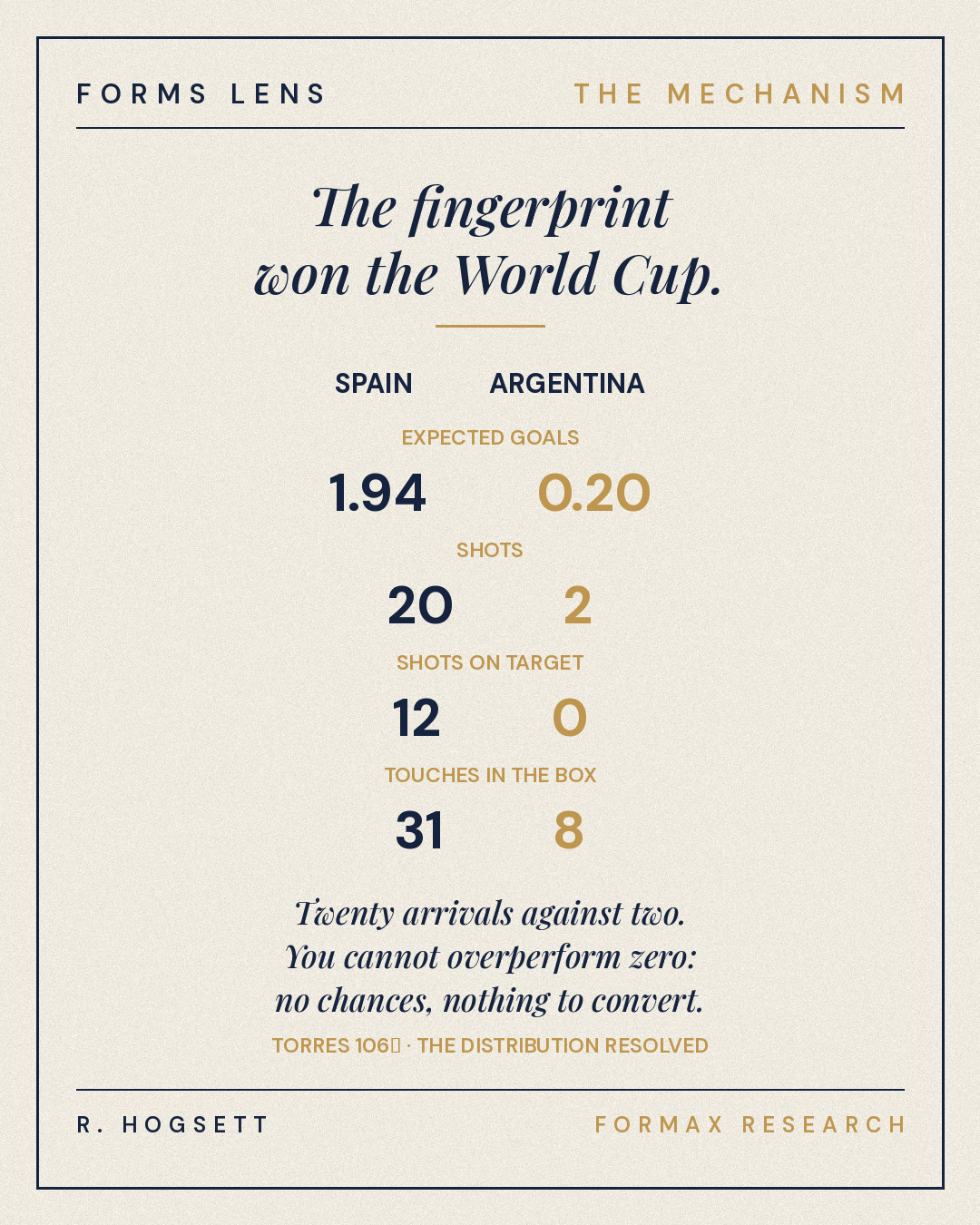
I said: watch whether Spain’s constructed arrivals climb at their normal rhythm. They did, relentlessly, all night. 20 shots, 12 on target, 31 one touches in Argentina’s box, 1.94 expected goals. For 104 of the 106 minutes it took to win, Spain had nothing on the scoreboard and everything else, which may make it the most dominant goalless performance a World Cup final has ever contained. The goal, when it finally came, was not a break from that pattern. It was the pattern paying out.
I said: watch Argentina’s first great chance, and what happens to it. It never came. Two shots in the entire match. Zero on target. Eight touches in Spain’s box across 120 minutes. Expected goals: 0.20, and most of that arrived in desperation, a man down, chasing a game already gone. I wrote this morning, in a sentence I did not know would be this literal: a gap cannot close on a chance that never arrives. Argentina scored 19 goals in seven matches by outrunning their process. In the final, they generated no process to outrun. You cannot overperform zero.
Let me put that plainly, because it is the whole match in one idea. Expected goals measures the quality of the chances a team creates. Argentina spent the tournament creating a modest number of chances and squeezing extra goals out of them, converting at a rate above what those chances deserved. That is a skill, and it is a real one. But it is a bonus applied to chances, the way a percentage is applied to a number. It has to have something to multiply. In the final, Spain did not out-defend Argentina’s finishing. Spain removed the chances entirely, and a finishing bonus applied to no chances is nothing, because any percentage of zero is zero. Argentina did not lose their touch tonight. Their touch became irrelevant, because Spain attacked the thing that comes before the touch. You cannot out-finish chances you were never allowed to create.
The mathematics of a scoreless hour
Here is the part that separates analysis from commentary. When Spain went to the interval at 0.10 expected goals and the match sat scoreless deep into the second half, the broadcasts reached for the word “wasteful.” The mathematics reach for a different word: expected.
A team’s probability of scoring zero goals from a bundle of chances is governed by the Poisson distribution. At the point when Spain had generated roughly 1.4 expected goals, the probability of them having scored exactly zero was e to the power of -1.4, which is 25%. A scoreless Spain was not an anomaly requiring explanation. It was a one-in-four branch of the same distribution that also contained the goal, playing out in real time while an inspired goalkeeper held the other three branches at bay. Emi Martinez was excellent.
In plain terms: chances worth 1.4 goals do not mean a team scores. They mean a team scores most of the time, and comes up empty about a quarter of the time, the way a heavily weighted coin still lands the wrong way now and then. Spain were not wasteful. They were living inside the quarter of the distribution where the goal has not arrived yet, and a goalkeeper having the game of his life was holding them there. Emiliano Martinez made a World Cup final record number of saves tonight. That is not evidence against Spanish dominance. It is the mechanism by which a 25% outcome stays visible long enough to look like a story.
The goal, when it came, was not a departure from the pattern. It was the pattern completing. Enough constructed arrivals, for enough minutes, against a defense reduced to ten men, and the distribution collapses toward its mean. Torres finishing in the 106th minute is what 1.94 expected goals looks like when it finally resolves.
Why this is the whole thesis in ninety minutes plus thirty
For two weeks I stress-tested my thinking against every check I could build. Plenty of assumptions broke along the way, the way they should. What survived is this: a team’s quality is written across hundreds of actions a match and read back from only a handful of goals, and the gap between how fully it is written and how sparsely it is read is where every misleading scoreline lives. Spain are the purest embodiment of that idea I have ever measured, and tonight they won the World Cup by it, in the most literal possible fashion, dominating every measurable dimension of football for two hours and converting exactly once, exactly when the distribution said a dominant team eventually must.
And the value of an attack, I have argued, is not the chance it produces but the reproducibility of the route that produced it. Argentina’s route was not reproducible. It was a month-long overperformance of a modest process, brilliant, thrilling, and mathematically a loan. Tonight the loan came due, on the largest stage in the sport, at the exact moment they could least afford to repay it. The gap closed. It closed the way I said gaps close: without warning, all at once, against the team that had been living in it.
The mark
I called it before it happened. I called it more boldly than the industry’s best model. I told you the mechanism, and the mechanism is what won. I told you the shape of the 90 minutes, and the 90 minutes took that shape. And I did all of it in public, timestamped, at forms-markov.netlify.app, where the record has sat since before the semifinals I also called.
This is what it looks like when you understand football at the level of its mathematics rather than its noise. Not a prediction. A reading. The difference is that a prediction names a result, and a reading explains the machine that produces it; only one of those can be right for the right reasons.
Spain are world champions. The fingerprint won. And the person who told you it would, and why, and how, was not a supercomputer or a syndicate or a broadcaster.
It was me.
Method: expected goals for all 104 tournament matches from Opta figures as published in match reports. Final-match data: 1.94 xG Spain, 0.20 Argentina, 20 shots to 2, 31 box touches to 8, official via ESPN and Yahoo Sports. Model: time-decayed Dixon-Coles on xG, refit through the semifinals, all parameters, backtests, and the pre-kickoff forecast public and timestamped at forms-markov.netlify.app. Semifinals and final all called in advance and graded.
FORMAX Research is the analytics arm of Forms Academy, a Cognia accredited K-12 school and player development program in North Texas and Madrid. We study the professional game to understand what technical development is worth.
R. HOGSETT · FORMAX RESEARCH
Thanks for reading! Subscribe for free to receive new posts and support my work.