R. Hogsett · FORMAX Research · Forms Academy
Sunday’s victory was the visible return on developmental decisions made decades earlier. Spain did not win Sunday night. Spain won long before Sunday night, and the final was simply the moment the return came due.
That single reframing is the whole developmental argument, and it is the reason I have spent thirteen years obsessed with one thing above all others in a young player: functional technique. Not tactics, not athleticism, not results on a Saturday. Technique built so deep it runs without supervision, portable into any system and adaptable to any pressure the game has never shown the player before. Sunday, the most-watched football match on earth showed why.
The output of a decision made a generation ago
The team that lifted the World Cup was built on a national methodology decision taken long ago: prioritize technical security and positional intelligence over athletic selection at youth ages, and hold that line through years of producing players who looked too small, too slow, too patient to the rest of the world. La Masia and the wider Spanish model believed that functionally technical players would compound into something the athletic model could not reach. For years the approach looked indulgent. Then 2008, 2010, and 2012 happened, and the doubters went quiet. Then a long dry spell, results plateauing, the old questions resurfacing. Then a deliberate rebuild on the same principle. Then Sunday night, with a teenager in Yamal creating and a teenager in Cubarsí defending, a midfield that arrived twenty times and conceded two shots.
That is the arc I organize my entire academy around. Paradigm, patience, output. It is not a metaphor for how we develop players at Forms. It is the same claim, run at national scale, with the results now in.
What “technical” actually means
I want to be exact here, because the loose version of this argument is what every academy already claims, and the exact version is what almost none of them can execute.
Not all technique is the same thing. There is elementary technique, the ability to perform an action in isolation. There is dynamic technique, the ability to perform it in motion. And there is functional technique, the ability to perform it automatically, under pressure, while the mind is occupied with something else entirely. The game is played at the third level. A player who can execute only when he has time and space can execute only when the game allows it, which at the highest level is almost never.
This is the distinction that matters, and it points to something most developmental writing misses. Technique exists to free the brain. When receiving, protecting, and moving the ball no longer consume a player’s attention, that attention becomes available for perception, for anticipation, for deciding. The technically secure player is not merely cleaner on the ball. He is calmer in the mind, because his execution is not spending the cognitive bandwidth his decisions require. Spain did not simply have better technique than Argentina. Spain had players whose technique cost them nothing to use, which left everything else free.
And this is why capacity comes before perception, not after it. A player does not perceive every solution on the field. He perceives the solutions his body can actually attempt, because the mind does not seriously consider a pass it cannot reliably make. Expand a player’s technical capacity and you expand what he is able to see, because you expand what he is able to try. Perception follows capacity. This is why we build the base first. We are not just training feet. We are widening the set of options the player’s mind is even willing to look at.
Capacity first, systems second
A system, whether Spanish positional play or the Forms curriculum, is a set of instructions for what to do with technical capacity. If the capacity is not there, the instructions have nothing to run on. The system is the exponent. Functional technique is the number the exponent is applied to. Raise a small number to a large power, and you still get very little. A sophisticated positional system applied to insufficient technique does not produce sophisticated football. It simply organizes the limitations. Multiplication preserves zeros.
Spain had the order right. The base was laid first, over years, one player at a time. The system was applied to that base. The output arrived on schedule, which is to say a decade later, which is to say exactly when a compounding process is supposed to pay.
Why Sunday proved the developmental point, not just the tactical one
Here is the connection most people who watched the final will miss, and it is the one I care about most, because it is the actual thesis of my work.
The reason Spain’s play was reproducible on Sunday is that it was built into the players, not into the game plan. A team can be coached to press or to sit deep for one match. A team cannot be coached, in a week, to arrive in the box twenty times against a World Cup defense. That capability is the accumulated residue of a decade of individual technical development in each player. Reproducibility on the pitch is the professional-age signature of functional technique trained at youth age. The thing my research measured as a team property, the fingerprint, is the sum of things trained into individuals long before they ever met each other.
So when I say the value of an attack is the reproducibility of the route that produced it, I am describing, at the team level, exactly what a developmental methodology is trying to install at the player level. Portable, adaptable, functional technique is what makes a route reproducible under pressure it has never seen before. Argentina had brilliance that depended on specific players in specific moments. Spain had a method that survived substitutions, a red card, extra time, and a goalkeeper playing the match of his life. Method survives conditions. Brilliance depends on them. That is the entire case for developing functionally technical players instead of collecting effective ones.
Why patience is not a virtue but a necessity in development
The hardest part of this work is not knowing what to build. It is surviving the years between building it and seeing it.
Technical development compounds, and compounding is invisible until late. A player built for control looks worse at eleven than a player built for speed, because at eleven the game rewards the sprinter and punishes the child taking the extra touch to do it properly. The gap does not close on the schedule a parent wants. It closes later, and there is a mechanism for why. Early physical maturation temporarily masks technical difference. The bigger, faster child wins now on maturity the others have not yet reached. But physical advantage regresses toward the mean as everyone matures, and when it does, the athletic edge that looked decisive at twelve is simply gone. What remains is what was built underneath, and technical difference does not regress. It compounds. By the time the physical field levels, the child who was outrun for years is the one still standing, and it is too late for the others to build what he built.
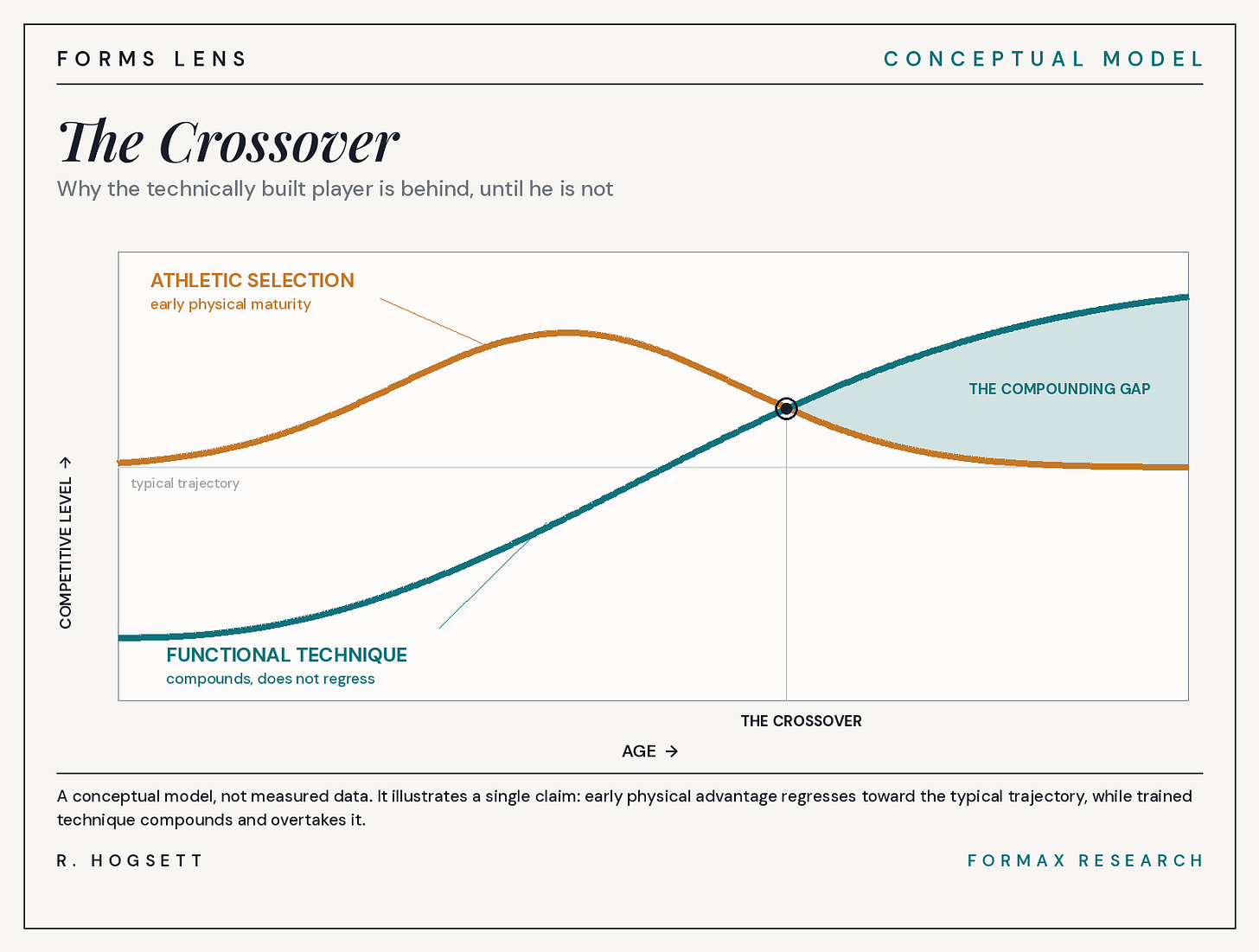 This is why patience in development is not a personality trait or a nice value on a wall. It is a mathematical requirement of the thing being built. You cannot rush a process whose entire value is that it compounds, any more than you can rush interest. Youth football is obsessed with today’s outputs. Development is obsessed with tomorrow’s causes. Those are not the same project, and they are often opposite ones.
Every time a family is tempted to move a child to the club that wins now, the club that plays the biggest and fastest and collects the most trophies at under twelve, they are choosing brilliance that depends on conditions over method that survives them. Sunday is what the other choice looks like, twelve years later.
The honest limit
Spain is the strongest modern evidence I can point to for the paradigm. It is powerful evidence, at national scale, in front of the entire world, that technical development held with patience compounds into something the athletic model cannot reach. Evidence is not proof, and one tournament cannot prove a developmental theory. But if you wanted to design the single most visible test of the idea, you could not do better than a World Cup final, and the idea passed.
What it does not settle is whether any single academy, mine included, executes the paradigm well. That is a separate question, answered by different evidence: the players an academy actually produces, tracked honestly over years. Spain is evidence that the road is real. Whether a given school walks it well is a claim only that school’s own graduates can settle, and I would not ask you to take it on the strength of a match played by other people’s players. What the final supported is the direction. Capacity first. Systems second. Patience throughout. Output last, and late, and worth it.
I have been driving that road for thirteen years. This past Sunday, I watched where it leads.
For those who select young players: every roster is a thesis about what develops and what merely arrives early. What is yours claiming?"
FORMAX Research is the analytics arm of Forms Academy, a Cognia-accredited K-12 school and player development program in North Texas and Madrid. We study the professional game to understand what technical development is worth, and we build our players on the answer.
R. HOGSETT · Forms Academy
Thanks for reading! This post is public so feel free to share it.