FORMAX Research, Item No. 02, Part 2. Companion to The Arrival Rate.
Part 1 made the senior case. A goal records one attack. Recurrence asks whether the team can run it again. At the World Cup that distinction already holds: goal distribution across halves is inconsistent, even less so match to match.
Now make the players nine years old
Everything above was measured at the summit of the sport, with adult professionals, elite goalkeepers, full-size pitches and the largest scouting apparatus in football history watching every touch. Even there, one attack in 12 produces a goal; the winner has the weaker machine nearly 40% of the time, and a single match of goals performs no better than a coin flip.
Now walk down to a U-10 pitch on a Saturday morning and listen to how children get evaluated.
“He scored twice; he had a great game”, “She did not score; she disappeared,” or “That team won 6-1; they are the better team.” Each of those sentences repeats the error this paper has spent its entire argument dismantling, and repeats it under worse conditions, because everything that makes goals unreliable at the World Cup is amplified in children’s football. The samples are smaller, the goalkeepers are still learning to dive, the bounces are wilder, early physical maturity creates enormous mismatches, and a single transient event, such as a long ball over a nine-year-old defense, converts at rates no professional attack ever reaches. A children’s scoreboard carries less information than an adult scoreboard, which already carries very little.
The consequences are also asymmetric, because in youth football the scoreboard does more than misreport; it selects players, it (mis)guides parents, it interrupts the growth process. The boy who scores off chaos earns praise and an invitation to the academy team. The girl who generated the same clean entry through the left half-space 11 times against players a year older, and watched teammates miss all 11, gets told she needs to be more of a goal threat, brave, or “a dog.” Clubs do not develop these children so much as sort them. Each year they hunt results, keep whoever already produces said “results”, and recruit a fresh crop to replace the rest. Almost none of it is talent identification, and even less is development, because a club that improved its players would not need to replace them every year. This is my opinion, but it’s also math. If children were actually growing inside these environments, you would see the same names getting better year over year. Instead, you see turnover, a roster refreshed by recruitment rather than raised by coaching, which is the signature of a system built for harvest and replacement rather than growth. That is what the results reward, and that is what clubs deliver.
There is a quieter cost as well. Coaching for results teaches transient states. If Saturday’s verdict is the goal count, the rational coach of children plays the early-maturing striker up front, launches the ball over the press and relies on chaos. That approach wins at nine years old. It is also transient in the strict sense, because it depends on states of the game that disappear as players age and the game organizes: the opponent’s error, the physical mismatch, the unguarded second ball. The mechanisms never get built because nothing about the weekend rewards a coach for building them.
What building the machine actually costs
A machine cannot be installed in a season, and at youth ages it cannot be installed at all until the technical base is in place to support it. A nine-year-old cannot repeat a central entry through midfield while the skill it depends on, receiving on the half-turn under pressure, is still uncertain. The mechanism breaks at its weakest link every time it is attempted. Technical automaticity frees perception: the two develop together, but the tactical demand cannot outrun what the player is able to execute. A player who no longer has to think about controlling the ball can see the pass that makes the mechanism work, whereas a player still working on the first touch cannot see it at all. That is why the technical work comes first and why it is measured in years rather than weeks.
Patience is the harder requirement, because the building period looks identical to underperformance. A group learning to construct central entries will lose to a group that lines up four or five players high to rush the build-up, or to a team that punts the ball over the top for its biggest player, and will keep losing for a while. The results will show no progress during that period, because results are not what is progressing. The only visible evidence is the count of build-outs, arrivals and repeats, which is exactly the evidence of growth nobody notices or records at the youth level. A coach who cannot demonstrate progress on the scoresheet tends to get replaced by parents or the club, so most coaches revert to the method that produces goals this weekend.
I watch this happen every season with our own eight-year-olds. We teach them to build out from the back, which means playing the ball out of our own penalty area under pressure rather than hammering it away. The opposing coaches know we do this. So they load their players high, push everyone up to the edge of our box, and send them charging at our children the moment our goalkeeper releases the ball. It is the hardest possible situation to ask a small child to solve.
I do not let them solve it the easy way. They are not allowed to kick it clear, not allowed to get rid of it, not allowed to de-risk. They face the pressure, they take the touch, they dribble out. And for the first several games they fail, over and over, in front of everyone. We lose by absurd margins. Nine-nothing, ten-nothing, worse. Every goal we give up looks like a catastrophe, and every one of them is a child trying to do the hard thing and not managing it yet.
A year later, those same children do not lose the ball. They build out of the back nearly every time, against pressure that used to bury them, and they are calm doing it. The turnovers simply stop. They have become technical and, more than that, fearless, because they spent a year solving the exact problem that frightens everyone else into kicking it away.
The parents who stayed lived through both. But many of them only saw the first part. They saw the ten-nothing losses and the easy goals, and they did not notice what those losses were building. The scoreboard was screaming failure for a full year while the most important development of their child’s life as a player was happening underneath it. The score was the lagging indicator, but the building was the machine. The parents who understood that watched a different season than those who only read the results.
Intention is the third requirement and the one most often absent, and it needs to be stated precisely because it is easily mistaken for something it is not. A reproducible attacking identity does not emerge from playing matches alone. It comes from deciding in advance which situations a group will learn to solve, designing sessions so those situations occur hundreds of times under steadily increasing pressure, and holding to that decision through the months when the scoreboard argues against it. What repeats is the situation and the principle. The solution cannot be scripted, and a scripted one would not survive an opponent who adapts.
Spain’s own data makes the distinction concrete. Their three signature mechanisms produced 29 entries across the tournament. Twelve different players executed the final action, seven different players received it inside the box, and of the passing combinations involved, eleven occurred exactly once. Six to nine players touched the ball in a typical possession of this kind. The same three patterns appeared 29 times, carried out by a shifting cast of players rather than the same few. That is not a rehearsed routine; it’s not the choreography I see youth coaches drilling with their team. Instead, it’s a situation the team knows how to solve, being solved by whichever players are in position, which is only possible when those players individually hold the capacity to solve it.
The between-match evidence says the same thing at a larger scale. Among the 36 tournament runs of five matches or more in this sample, the average team’s steadiest mechanism repeated in 58% of its matches. Spain’s steadiest repeated in three of seven, placing them in the bottom third of the thirty-six. Twenty different mechanism classes recurred across their seven matches, nine of them in exactly one match, against exactly one opponent. The champions did not carry a routine from match to match. They carried the capacity to build whichever route the specific opponent left open, and repeated it that day.
England at the 2018 World Cup are the other pole. One mechanism, a direct entry through the right half-space from a high turnover, recurred in all seven of their matches. Nineteen entries, 2.6 expected goals, one goal. That is what a script looks like in the data: reliable, present every match, and producing less each time it is read. England had a script. Spain had a vocabulary. A script is one solution memorized. A vocabulary is the capacity to compose the solution the moment demands, and only the second survives an opponent who has read the file.
This is the line we hold at Forms. Technique first, and for longer than most find comfortable. No tactical demand beyond what the player’s technical base supports. Assessment based on what a player can produce repeatedly rather than on what happened to work out. What repeats compounds, and that is the whole reason to be patient: it survives halftime, it survives the season, and it survives the growth spurt that erases the advantage held by whoever matured first. The aim is not a player who executes one team’s patterns. It is a player who recognizes the situation, selects the action, executes it under pressure, and can carry that capability into any system they later join. The goals arrive later, from a source that holds. Even World Cup attacks convert at 8.4%. The goal was never the measurement.
What recurrence does not measure
Recurrence is a team measurement and should not be asked to do work it cannot do. It establishes that a mechanism was reproduced. It does not establish which player made that possible, whether the execution was technically clean or merely successful, whether the decision was read correctly or arrived at late and rescued by a teammate, how quickly the situation was recognized, whether the same capability holds when the player changes position or opponent, or whether it survives pressure greater than the match happened to apply.
Those questions are the substance of individual development, and they require individual assessment: technical precision, speed of perception and decision, functional application in the game, physical integration, and psychological readiness under load. A team can post a high recurrence count while carrying a player who contributes nothing to it, and a player can be developing well inside a team that reproduces very little.
Recurrence and individual capacity are not in tension; one is built from the other. A mechanism that 12 different players can execute exists only because each player individually has the capacity to execute it. Take away any one player’s technical base, and that player becomes the link where the pattern breaks. Team recurrence is therefore strong evidence about an environment, about whether a group is being taught to solve repeatable situations rather than to chase outcomes, and weak evidence about any particular child inside it. Read it as a measure of what a program is building. Assess the player separately, and on the dimensions that describe a player.
What repetition demands of players
Recurrence names no individual, but it does establish something firm about the group, and the argument runs through the weakest link in a chain.
A mechanism that reproduces regardless of who executes it can only exist if everyone who might execute it is capable of executing it. Across the 723 repeated mechanism classes in this sample, the single most frequent executor accounts for only about two-fifths of the entries in his own team’s pattern, and roughly four different players execute the same mechanism within one tournament. Spain’s three signature patterns were executed by 12 players and received by seven, with 11 of the passing combinations occurring exactly once. The pattern does not live in a player; it lives in the group, and on any given repetition it is available to whichever players are in position.
I tested whether constructed mechanisms spread execution across more players than direct ones do, expecting that they would. They do not. Concentration is close to identical either way. What differs is the number of players the ball has to pass through on the way. A constructed entry moves through about nine players during a possession, compared to about four for a direct one. The count itself is arithmetic, since longer builds contain more passes, but the consequences are not. A reproducible constructed mechanism has roughly twice as many links, and every link has to hold under pressure. One player in that chain who cannot receive while facing a defender, cannot turn, or needs two touches where one is available is a point at which the mechanism fails. It will be found, because the mechanism will be attempted again and again.
This is why technique is the precondition for everything a team can reproduce rather than one attribute among several. A direct system can conceal some technical limitations for longer, because the ball reaches any given player less often and more often through the air. A reproducible associative system conceals them barely at all, because every constructed attack routes the ball through most of the team, and repetition puts each of those players under the same test again and again. A weak link is found not because anyone targets it, but because the attacks that break down keep breaking down in the same place, and the place is a player.
The measurement cannot quite prove the strongest version of that claim, and it’s worth being honest about why. This data only includes attacks that succeeded in reaching the box. Every attack that broke down is missing, which means the very evidence that reveals a weak link, the map of where attacks die, is the evidence this dataset does not contain. I am only ever looking at the times the chain held, and reasoning backward from them. A weaker player can hide in that data: the ball can avoid him, he can be handed the easy touches, or he can be the reason for the failures that were never counted in the first place. Concluding that every player is capable when you have only studied the plays that worked will always make the group look better than it is.
So the defensible statement is narrower than the pedagogically satisfying one. The repeatability of an associative mechanism is constrained by the technical reliability of every player the mechanism regularly calls on. Recurrence is evidence that a group has built a technical base broad enough to sustain the pattern across changing personnel, and 12 executors across Spain’s signature entries is real breadth. It does not measure any individual’s technical level, nor does it establish that the 14th player could have done it. That still requires assessing the player.
Why repetition is affordable
There is a question sitting underneath this paper that I have not answered until now. Repeating a mechanism 20 times means failing at it most of those times, because even at the World Cup only one attack in 12 converts. Every one of those failures is a ball surrendered. So why doesn’t a team that attacks this way get punished for it?
The answer lies in what happens in the 15 seconds after possession is lost, and it requires careful measurement, because better teams build longer sequences and would look safer for reasons unrelated to construction. So I compared each team against itself: the same side’s short possessions against its own long ones, across 20,151 possessions that reached the attacking half.
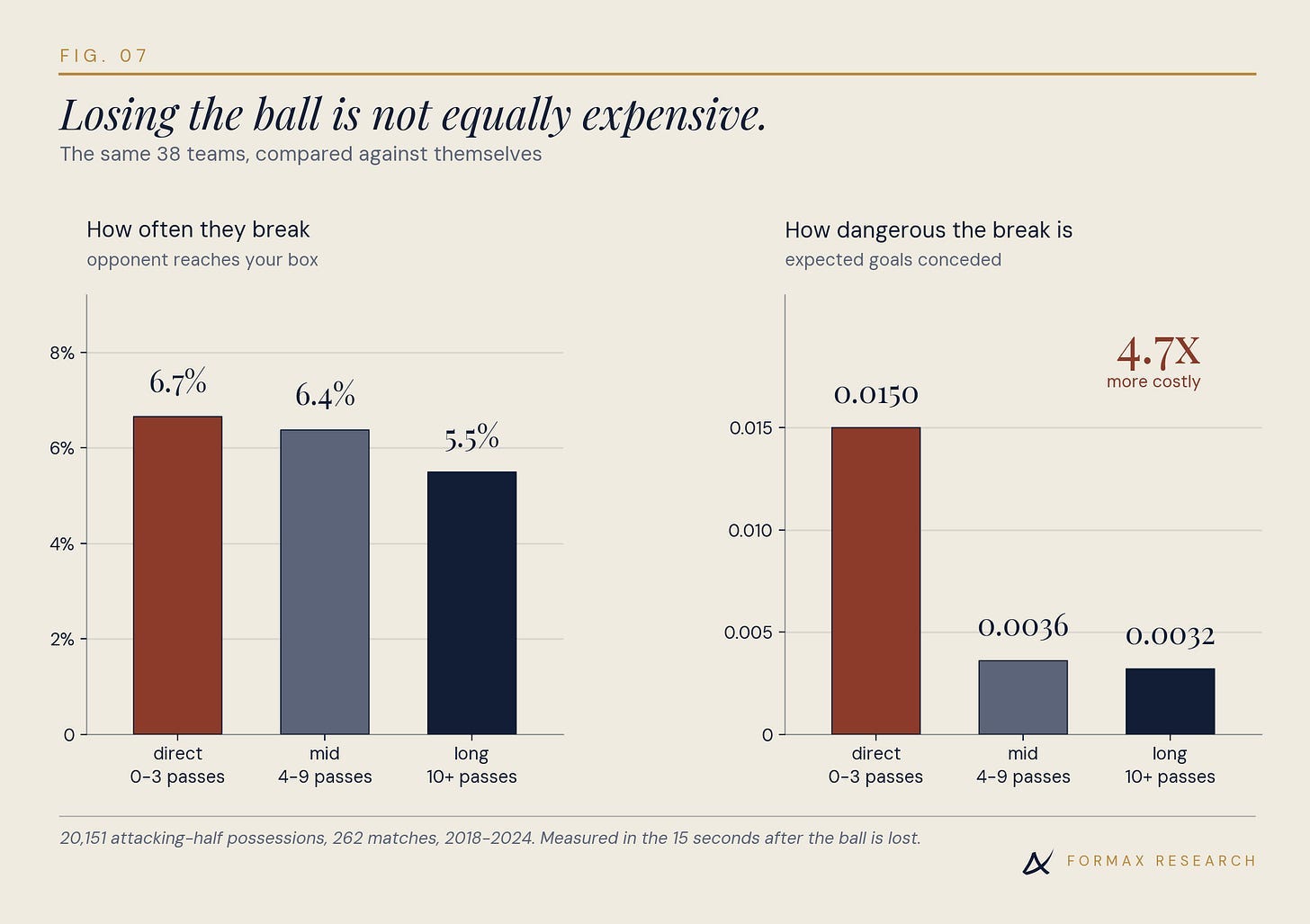 The frequency of counterattacks barely moves. After a direct attack breaks down, the opponent reaches the penalty area within 15 seconds 6.7% of the time. After a long build, 5.5%. What changes is the value of those counterattacks. Expected goals conceded in that window run at 0.0150 after a direct attack, and 0.0032 after a long build, a factor of 4.7, and 30 of the 38 teams show the effect individually. The opponent breaks about as often either way. The break is nearly five times less dangerous when it comes against a side that had constructed its attack.
The likely mechanism is not unclear. A side that has moved the ball through nine players to arrive has bodies near the ball, distances that can be covered, and a shape already organized behind the play. A side that has sent the ball forward in three passes is stretched when it loses possession, and the opponent breaks into space rather than into people. Event data records touches, not positions, so the shape itself is invisible here. But the pattern is exactly what organized rest defense predicts, and the 4.7x is what its absence costs.
That finding closes the circuit, but it needs to be read correctly, because the naive version gets the styles backward. Chance for chance, the direct attack is actually the more dangerous one: 0.170 expected goals per shot against 0.090, and more expected goals per arrival too, because it strikes at defenses before they organize. If you judged the two styles one chance at a time, kick-and-rush would win. But that’s not how football works.
The associative style does not compete on the value of a single arrival; rather, it competes on how many arrivals it manufactures, how reliably it can create them, and how little it concedes when they break down. The direct side takes a rare, high-value swing and, when it misses, hands over a transition nearly five times more dangerous. The constructed side can produce many lower-value arrivals on demand and simultaneously incurs less risk than the direct side’s approach for any that fail. Over 90 minutes, the second model produces more total threat and surrenders less, which is why it wins despite losing every individual chance-quality comparison.
This is the resolution of the whole series: A single constructed attack is not better than a single direct one. The superiority is never in the instance; it is in the rate, the repeatability, and the survivability, three things that exist only across many attempts and vanish the moment you evaluate one chance in isolation. Reproducibility is not a property of the attack; more clearly, it’s a property of the attack, multiplied across a match, plus the structure that survives its failures.
This closes a loop running through this series. The Arrival Rate showed that the difference between constructed and direct football is a rate rather than a difference in the quality of chances, with the constructed side arriving twice as often for chances of almost identical value. The work that followed showed that technical security carries no value read on its own and behaves as a multiplier on arrivals, which is why possession that circulates without progressing is sterile and produces no arrivals, and arrivals are what the numbers count. This paper supplies the mechanism joining the two. Security multiplies arrivals because it makes arrivals repeatable; arrivals become repeatable only when enough players can be relied upon to perform the same actions under pressure, and a team can keep repeating only because the structure that produces the attack also survives its failure.
As a coach or a parent, what to count instead
For a coach or a parent, none of this requires software. It simply requires a different question after the match. Not how many we scored, but how many times we arrived, and how many of those arrivals showed the team solving the same problem again, each time, however, as the moment demanded. If the team kept solving the same situation to arrive, and you saw it three times, that was not luck. It was a capability, and a capability is what shows up again next match.
For a parent on a touchline, none of this means going quiet when your child scores. Cheer the goal; everyone will, and they should. The change is what else gets your voice, because right now the goal is the only thing on the pitch that gets celebrated, and it is the least informative thing happening out there. The actions worth adding to your repertoire are the ones that will still be there when the child is sixteen. The first touch that moves the ball away from the defender rather than into pressure. The pass received on the half-turn, which turns a sideways possession into a forward one. The dribble that takes on a defender rather than getting rid of the ball deserves praise, even when it fails, because the attempt is where skill is built. The run that gives a teammate an option, the kind that never shows up on the scoresheet and that the team cannot function without. The switch that drags the opposing block across the pitch. Knowing when the ball can be kept alive under pressure so the team can build again, and when it cannot.
Those are the actions that show a child is learning progressive possession and associative play, which is what keeping the ball actually means in our method. Not denying possession to the opponent, but using it to find and conquer space. Those actions provide stronger evidence of development than a goal produced by a deflection, and over time that difference becomes increasingly visible. Cheer the participation and cheer the execution. The goal is a byproduct, and at 8.4% even in the best football on earth it is a slow and unreliable way to learn what your child can do.
A final clarification about scope. Results matter, and professional adults are paid in them. The argument here concerns inference: what a result is evidence of, which turns out to be very little, and what a repeated mechanism is evidence of, which is a capability that will still be repeatedly available. Argentina’s federation acted on that distinction in November 2022. Nobody was dismissed after Doha, because the staff could see 16 arrivals and 12 repetitions in a match the rest of the world had already filed as a disaster.
The scoreboard is the weakest evidence we have. The process is the fingerprint. That is true of a football team, and it is true of a child learning the game: what they can repeat is what they have actually learned, and the result on any given day is mostly happenstance. We have spent years building a place that teaches this way and has the patience to be judged this way. The same principle is embedded in our Academy and in our Residency; that is our mission, and it is worth doing carefully.
Data: Data and limits are in Part 1.