A parent asked me a question recently that I think a lot of thoughtful parents arrive at eventually. His daughter is eight. He watches every game she plays, he understands that touches and decisions are what build a player, and he had started to wonder whether her weekly league games were delivering enough of either. His proposal was reasonable on its face: lean heavily into futsal and small-sided games during the week, drop the weekly league, and use tournaments and a handful of selected games as a test of whether the work was transferring.
I want to take that question seriously, because a version of it is correct for older players and I run that model myself at the older ages. But at eight, nine, ten years old, the weekly league game is one of the best things a young player has, and I want to explain why.
What a game is
Training sessions are designed environments. We choose the constraints, the space, the numbers, the problem the player is meant to solve, and that control is exactly what makes a session effective. Ironically, it's also what limits it. A real opponent brings intent and randomness that no design can manufacture. Every game drops a player into a 360 degree theater where the movement patterns are new, the pressure arrives from angles she has not rehearsed, and the problems come at her on and off the ball in sequences no coach or training has scripted, with no pause or reset button when she gets one wrong. On top of that she gets opposed reps, again and again, against players who are trying to stop her.
At this age, a player is gathering data from real life exposure, and the volume of that data matters enormously. The more she sees, the more her brain has to work with, and the weekly game is the most consistent supply of it she will ever have.
Why "not challenging enough" is the wrong measure
Not necessarily this parent, but I do have this conversation quite frequently and I thought I would integrate into this as well. Most parents read and evaluate a game by the score or by the "perceived" quality of the opponent, and by that reading a comfortable win against a weaker side looks like a waste of time. I disagree with this notion and submit that the value of that game sits somewhere else entirely.
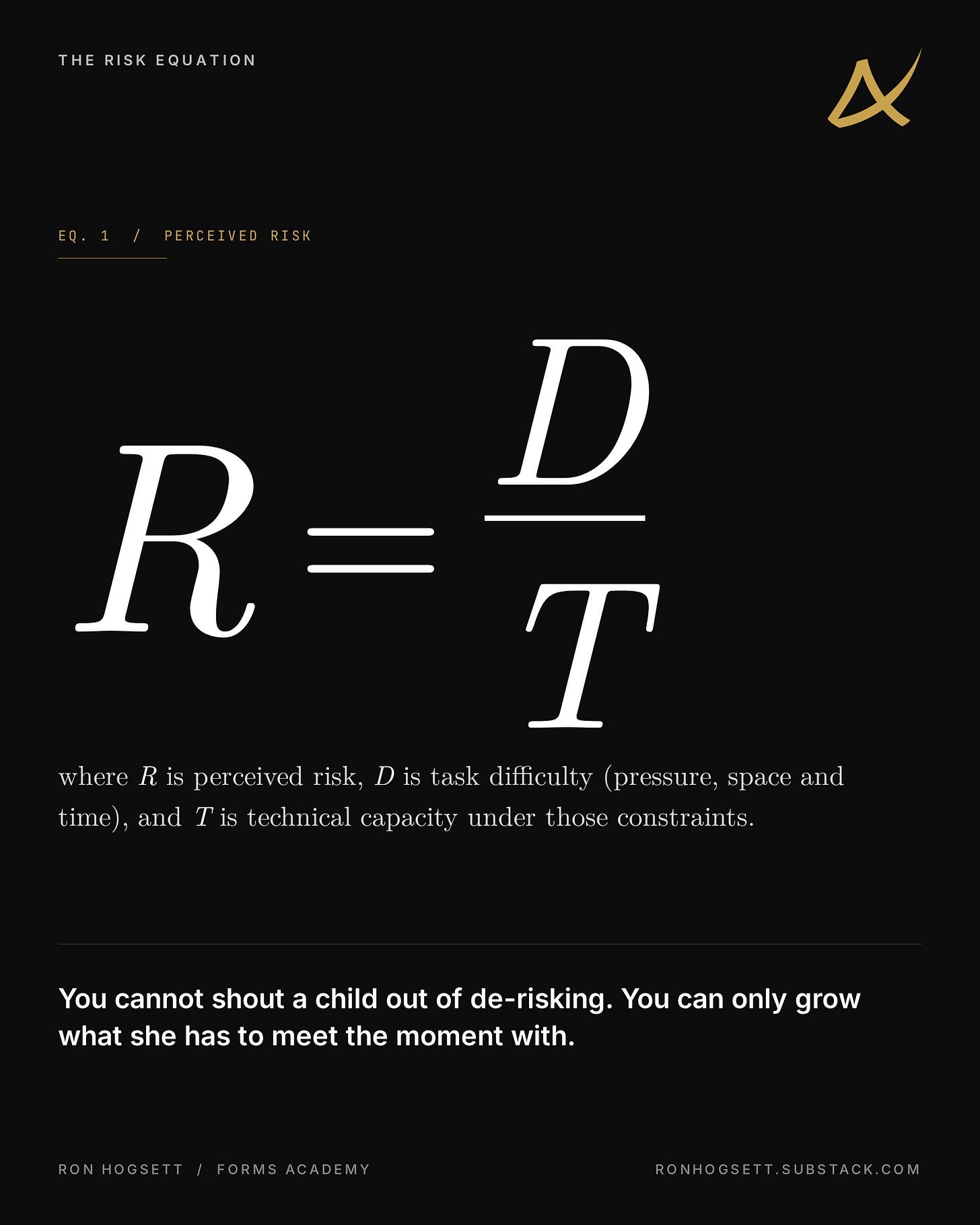
To see where it sits, it helps to understand how a young player experiences risk. In Forms we describe it with a simple relationship: perceived risk is task difficulty divided by technical capacity. Difficulty is the pressure, space and time the environment puts on the player. Technical capacity is what she can actually do under those constraints, in the game rather than in isolation. When capacity is low, even a simple problem feels dangerous, and a player who feels danger de-risks: she gets rid of the ball, freezes, or plays on pure reaction. From the sideline, it can look like a lack of courage, but the truth is it’s a lack of capacity, and it is the equation doing exactly what it does. As capacity rises, the same gap, the same marker and the same time window become usable. The game on the whiteboard never changed. What changed is what her capacity allows the environment to offer her.
A game against a weaker side lowers the difficulty, and that drops her perceived risk into the band where she is willing to attempt things. Against a side that gives her time and space, more of her sequences run all the way from thought through to execution and then to success, dopamine release and all. Each completed rep does two things at once. It builds confidence, and confidence is what makes a young player willing to try the next skill, the harder skill, the one she would never attempt with a defender on her back or in her face. It also grows her technical capacity, which means the same difficulty she meets against a stronger opponent later arrives as a lower risk. As that confidence grows she becomes mentally prepared to take more risk, and through taking risk she starts to understand the equation itself from the inside: what a move costs when it fails, what it earns when it lands, and when the trade is worth making. That understanding cannot be handed to her in a session. It gets built through reps that succeed, and weaker opposition supplies more of them than any other environment.
This is also why raising difficulty is never a shortcut. Push a player into games that exceed her capacity and you rehearse panic rather than intelligence. Scale difficulty to capacity, grow capacity, and the same game becomes safer on its own.
Every type of opposition does its own job
Weaker opponents expand what a player is willing to attempt. Stronger opponents test whether it holds under pressure. Peers sit in between and force the decision in real time, where the outcome could go either way. A league season delivers all three across its run, and that variety is the point. A schedule built only from stretched, difficult games would take away the confidence-building reps, and a schedule built only from easy games would never test them. Tournaments and futsal against other clubs then add stakes, compression and density on top of that base. Each competition supplies its own slice, and trading one away for another loses the slice.
Density and exposure are not competing goods
The parent's framing, and it is the common one, assumes that a game's yield is fixed: a league game gives you so many touches and so many decisions, a futsal session gives you more, so you should choose the futsal session. But the yield of a game is not fixed. How much a player gets out of a game depends on how the game is run and on what the player brings into it, and a player carrying confidence into a game brings more. Both of those are things a club can influence. So when a game looks thin on involvement, the answer is to run it better rather than to play fewer of them.
How we raise density inside the game
There are levers we control, and every one of them is a coaching responsibility rather than a scheduling one.
Roster size comes first. A roster small enough that every player gets long stretches on the field changes the math of every game before kickoff.
In-game coaching comes next. Our coaches coach during games, but within the methodology, shaping involvement live through questions and through the environment rather than through play-by-play commands. A coach who stands passive on the sideline is leaving involvement on the table, and that is on us to fix.
Role rotation matters because a player parked in one corner of the field meets the same problem every week. Moving her around puts different problems in front of her.
And every game has a purpose. The team goes in knowing what the game is for, and the game gets reviewed against that purpose afterward. A game with no stated purpose is a game that happens to a team rather than one the team uses.
The one thing to watch for
If you want to know whether the games are working, watch for involvement. Is she on the ball regularly, is she in duels, is she in the play. At this age that is the signal, and nearly everything else follows from it. A parent who sees a season of involved games has seen a season that worked, whatever the results table says.
When the format changes the math
None of this means the weekly league is forever. Once players move into 9v9 and 11v11, the bigger field and the extra bodies dilute involvement in a way 7v7 does not, and at that point weekly league play starts costing more than it returns. That is where futsal and small-sided density become the base of the program and tournaments become the test. The principle behind that shift is the same one I have laid out here. What moves is the format, and the format is what decides how much a game can give.
The instinct is right, the move is different
The parent who asked me this question was protecting his daughter's development window, and that instinct is exactly right. The move it should produce is playing each game with more intention and asking more of it, rather than playing fewer of them. At this age the league game is where she learns what she is willing to try, and that is not something we can afford to take away.
A quick question for parents out there, what’s the one thing you watch for in your child's games?