Most youth football trainers still teach skill as a script. The trainer names the movement, the player copies it, and the copied version gets repeated until it looks stable in the unopposed environment. Then the same player is asked to produce it in a match that never resembles the training environment. When the skill collapses under pressure, the explanation offered is usually the player deficit response, sometimes worse: effort or lack of talent. In my experience, the more honest explanation is that the task was designed poorly.
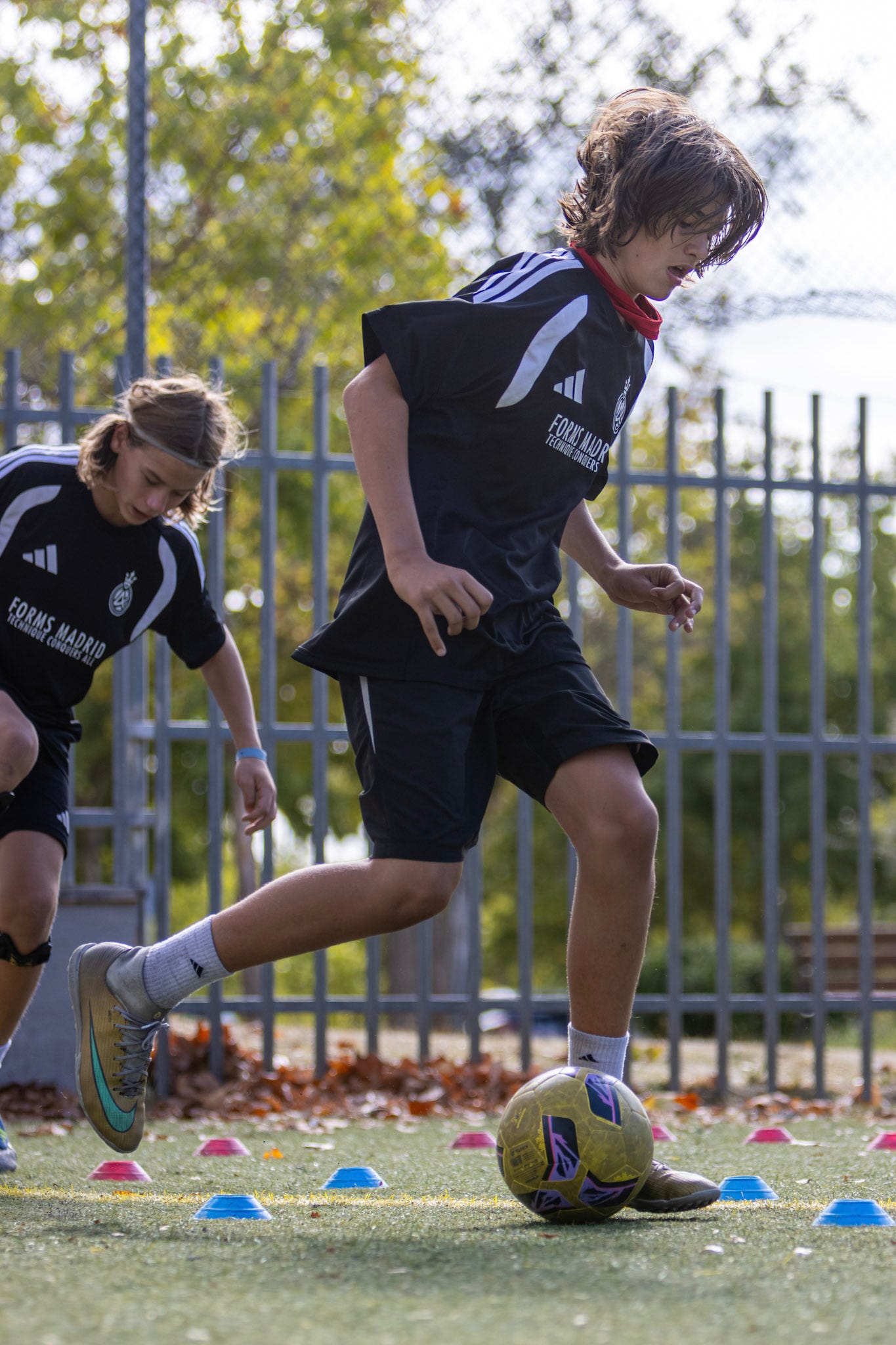
- Constraint-based learning begins from a different account of what movement is. Rather than being retrieved from a stored program and played back, a movement is assembled in the moment out of the interaction between the player, the task in front of him, and the environment he is in. Karl Newell set this out in 1986 in his work on the development of coordination: organismic constraints, task constraints, and environmental constraints jointly shape what the body can do, so that changing any one of them changes the solution the body arrives at. Newell's model is a framework rather than a settled mechanism, and some researchers still defend stored-program accounts. Still, it is the account that the last four decades of skill acquisition research have leaned toward, and it is the one FORMAX is built on.If movement emerges from interaction, the trainer's first job stops being describing an ideal first touch and becomes constructing a task in which a usable first touch is the easiest way out. FORMAX treats that design problem as the center of youth skill acquisition rather than as something added on after the real training is done.What a constraint actually isA constraint is a boundary placed on a task so that the easy ways around the problem disappear and the player is left with the problem itself. It has nothing to do with punishment or restriction for its own sake.Consider two ways of getting a nine-year-old's eyes off the ball. The first is to tell him to keep his head up, which adds a rule he has to hold in mind while he tries to control the ball, and which prescribes a posture rather than a purpose. The second is a dribbling task in which the gate he has to attack is revealed only after his first touch, or the defender he has to beat changes on a call, so the ball has to stay under him while his eyes look for information. At Forms we say eyes up rather than head up, because the player needs to discover a head position where the eyes can hold both the ball and the objective at once. As his control of the ball becomes proprioceptive, the eyes stop needing it and drift to the game on their own, without anyone asking them to.The difference shows up under pressure. Explicit instruction leaves the player with a set of rules, and Rich Masters' work on reinvestment has shown, mostly in laboratory tasks such as golf putting, that under stress, performers reach back for those rules and begin consciously steering a movement that had been running on its own. In neural terms, this is the explicit, prefrontal system taking back control of an action that the procedural system had already learned to run, and the movement gets slower and worse for it. The evidence for reinvestment in open invasion games is still thinner than the evidence in closed tasks, so I treat it as a documented route to failure rather than the whole story, but the direction is clear enough. A skill acquired through a well-built constraint carries fewer rules with it, which means there is less for a nervous player to reinvest.So constraint-based training does not mean the trainer stops instructing. It means the instruction moves upstream, into the design of the problem, and the player does the searching once the task is running. The search is where the learning happens.
#### Individual, task, and environment
Newell's three classes are the working vocabulary, and in coaching literature the first of them is usually called individual rather than organismic.Individual constraints are the player as he is today: his limb length, his footedness, how tired he is, how much he can hold in working memory, and what he already feels through the soles of his feet. These are not things you lecture away. You must account for them. A smaller player in a tight box is not a deficient version of a larger player but a different system with a different set of solutions available to him.Task constraints are the rules, the ball, the scoring, the number of touches allowed, the size of the grid, the condition that a goal only counts if it is scored with the non-dominant foot after a receive across the body. This is where most of the design work lives. Every task constraint is a hypothesis about which problem, repeated often enough, will grow the capacity you are focused on.Environmental constraints are the surface, the noise, the crowd of bodies, the pitch surface, the fact that the next pass is arriving from a teammate who is himself under pressure. Matches are dense with environmental constraints, and isolated technical circuits are almost lacking all of it, which is why a beautiful cone pattern so often dies in the first five minutes of a game. The skill was never asked to function as the game would require.At Forms, a session is designed as a stack of constraints rather than a list of drills. A stack might be 3v3 on a short, wide pitch, goals allowed only after the player has beaten his defender, the non-dominant foot as the only legal finishing surface, and a ball sized to punish a heavy first touch. None of those rules names a technique, and all of them make a particular class of technique the rational solution.
#### Why isolated repetition is the wrong unit
Repetition itself is not the problem. The problem is repetition that carries no new information.The nervous system does not need a thousand identical copies of a movement. It needs a thousand slightly different attempts at the same problem, so that the solution becomes robust to the noise a match will introduce. Bernstein called this repetition without repetition, and it explains why the movement variability you see in elite players is not sloppiness but a library of nearby solutions. Variation matters for neural reasons. The cerebellum learns by comparing what a movement was predicted to do with what it actually did, and it updates its internal model on the error. Identical repetitions produce almost no prediction error after the first few, so there is very little left for the cerebellum to learn from. Varied attempts at a stable problem keep feeding it the errors it needs.A cone line that produces the same foot path every time is efficient at producing a photograph of a skill and inefficient at producing a skill that survives a late tackle, a poor touch, or an imperfection on the playing surface. Constraint-based learning holds the problem steady and lets the movement vary, so the player is still repeating, but what he repeats is the act of finding a solution, not one fixed movement copied over and over.This is also, in my view, why early specialization built on closed circuits tends to fail technically. That is an inference from the specialization research rather than a direct finding of it, since that literature is mostly about sampling many sports against committing early to one. But the logic holds: hours accumulate, and they are hours spent performing a movement the environment has already made easy rather than hours spent solving anything. Mastery is what is left when the environment stops being easy.
#### Cognitive load is part of the technical problem
Every technical action has a cognitive cost, and attention is finite. Cowan's work on working memory puts the number of items an adult can actively hold at around four, and children hold fewer. Whatever the first touch consumes is not available for scanning, for the next pass, or for the run that should have started half a second earlier. A player who looks unintelligent on the ball is often a player whose first touch is still expensive cognitively. The decision was not poor. The budget, as so to speak, was already spent before he got to decide.There is a well-documented neural picture behind this. Early in learning a skill, control runs heavily through the prefrontal cortex and associative areas, the same networks that handle deliberate thought. As the skill is practiced, control shifts toward the basal ganglia and cerebellum, and the movement stops drawing on the prefrontal budget. Doyon and colleagues have mapped this shift across the cortico-striatal and cortico-cerebellar loops, and it is the neural form of what Fitts and Posner described decades earlier as the move from the cognitive stage to the autonomous one. A first touch that has crossed that threshold costs the player almost nothing to produce. One that has not is competing with the game for the same prefrontal resource.This is the claim that carries the FORMAX position of technique before tactics, and I want to be clear that it is a position rather than a finding. Ecological dynamics researchers tend to argue that perception, decision, and technique cannot be separated and should never be trained apart. I agree that technique should be developed inside opposed, constrained games rather than in isolation. Where I part from them is on sequence. Tactics are a demand on leftover attention. If the receive still requires conscious management there is no leftover, and you can draw the shape on a whiteboard all week without it mattering, because under a press it is not the drawing that fails.Constraint-based learning goes after that cost directly. The constraint is chosen so that the expensive part of the action cannot be avoided. A player who can escape a tight box by launching the ball long will launch the ball long, because that is what de-risking looks like when task difficulty has outrun technical capacity. Close that exit for a block of work and the receive has to improve, since there is no other legal way to stay in the game. Reopen the exit later and the cheaper touch is still there. That is acquisition. Used too early, the unrestricted game hands the learner a permanent escape route from the technical problem.Small-sided games earn their reputation only when they are designed with this in mind. A loose 5v5 with no scoring logic is a match with fewer people in it. The format becomes a developmental tool when the scoring, the space, and the legal actions force a specific class of perceive-and-solve cycles at a density the eleven-a-side game cannot supply.
#### Self-organization still has a designer
Players do self-organize, and the sentence is true in a way that can be badly misused. Self-organization means the system settles on a stable solution given the constraints in force. If the constraints reward kickball, the system organizes around kickball. If they reward a clean receive across the body, the system searches in that direction. The trainer remains responsible for what the system is allowed to become.That is why letting them play is an environment rather than a methodology. Sometimes it is the right environment. Often it is one that rewards the already strong and hides the thing you meant to build. Constraint-based training is the opposite of stepping back. It is tighter design with less talking.Once the task is running, the trainer's live job is to watch whether the constraint is doing what it was built to do. If the players have found a cheat that satisfies the rule without solving the problem, the rule is wrong, and the fix is a different constraint rather than a speech.
#### What this looks like on a pitch
A first-touch problem, properly stated, is that the next action is already late unless this receive creates it. One constraint for that problem is a grid too tight for a heavy touch to survive, with a point awarded only when the first touch takes the player into a new lane. The instruction never mentions the foot. The pitch geometry handles it.A weaker-foot problem is that the left foot has to become the only legal surface for the scoring action. Players will avoid that foot for years if the game lets them, and once the avoidance is removed, the volume appears. Volume on the neglected side is how bilateral development happens, through use-dependent plasticity in the motor cortex, and lectures about balance do not produce it.A scanning problem is that information behind the player has to be required for scoring. Put a target player in his blind quarter and make the only allowed pass the one that finds him, and the scan becomes the price of staying in the task.Each of these is a hypothesis that can be seen failing within a few minutes, and that is the standard. If the behavior you wanted does not begin to appear, the constraint is weak, and it should be replaced.
#### Where the boundaries of the argument sit
None of this argues against technique. It argues about how technique is grown. None of it argues against training. It argues against training that tries to operate inside the player's working memory while the action is happening.None of it requires every session to look like a match. Some constraints are deliberately tighter than the match, because acquisition sometimes needs exits closed that the match leaves open. Advocates of representative design are right that a task which drifts too far from the game risks building a skill the game will not recognize, which is why the exits are reopened, on purpose and later, when transfer is the thing being tested.And none of it claims that Newell, Bernstein, or the ecological dynamics school invented football. They described the learning dynamics the game was already using whenever a good trainer stopped talking long enough for a player to solve the problems in front of them.
#### How FORMAX uses the frame
Constraint-based training is one of the tools FORMAX is built on, alongside neuromotor enrichment, reflective praxis, and the rule that capacity should lead complexity. Scanning, opponents, and decisions all belong in a nine-year-old's environment. What is not allowed is for the tactical demand to outrun the technical capacity available to meet it.That ordering is an account of cognitive load rather than an ideology. Build the first touch, and the player can spend his attention on the game. Build the game first, and he will spend it surviving the first touch.The same logic runs through the rest of this series. Neuroplasticity and repetition thresholds ask how many informative attempts a young nervous system actually needs before a skill consolidates. Proprioception and ball mastery ask what the foot must feel before the head can be free. The cerebellum's role in technical skill asks why timing, not strength, is the scarce resource in early technique. Those papers are successive cuts of the same argument, rather than a pile of separate topics.
#### Practice implications
Design the problem before you name the solution. If the answer is easy, ask whether the task already forces it.
- Keep the problem stable and let the movement vary. Count successful solves rather than identical shapes.
- Close the easy exit while acquiring and reopen it when testing transfer.
- Watch for cheats. A constraint that can be satisfied without learning is just a rule.
- Protect leftover attention. While the first touch is still expensive, a tactical lecture on top of it is wasted.
- Treat the session as an experiment in which the constraint is the hypothesis. The players will tell you within minutes whether it is false.
#### Closing
The future of youth development will be decided less by who owns the most sophisticated vocabulary than by who can put a child in a problem that grows a skill the match will recognize. Constraint-based learning is the name for that design discipline, and Forms Academy exists to practice it at the level of daily task construction rather than as a slogan.
Skill is what the task made inevitable, long after anyone stopped telling the player what to do.
Ron Hogsett is the founder of Forms Academy and architect of FORMAX, a framework for youth football development focused on technical mastery, cognitive speed, and motor efficiency.
Explore the methodology at FormsAcademy.com
#### References
- Newell, K. M. (1986). Constraints on the development of coordination.
- Bernstein, N. A. on dexterity and repetition without repetition.
- Masters, R. S. W. on reinvestment and explicit instruction under pressure.
- Doyon, J. and Benali, H. (2005). Reorganization and plasticity in the adult brain during learning of motor skills.
- Cowan, N. (2001). The magical number 4 in short-term memory.
- Fitts, P. M. and Posner, M. I. (1967). Human Performance.